Matcha, Tencha, Gyokuro: Three Teas from the Same Shaded Garden
01 November, 2026
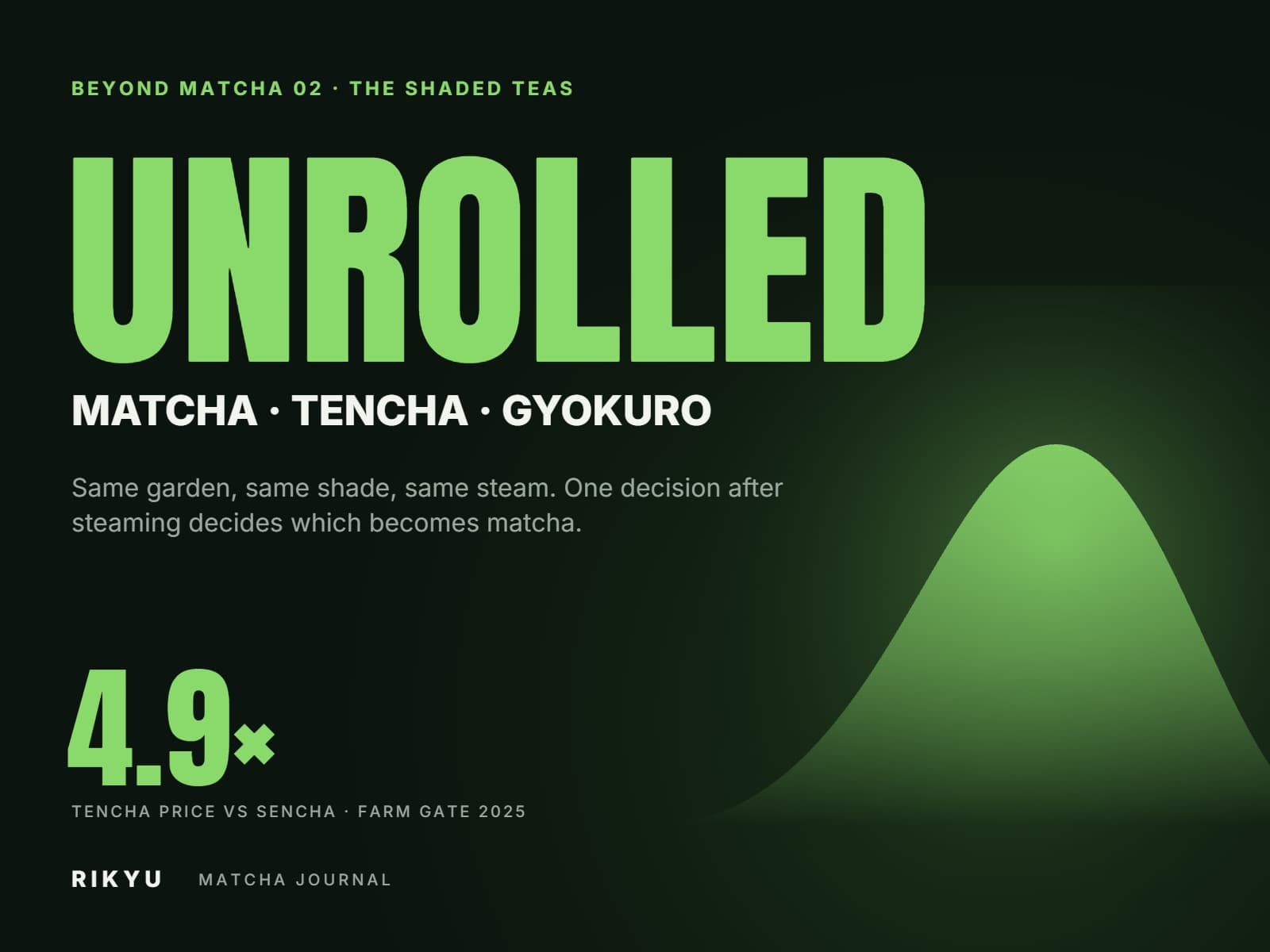
Matcha, tencha and gyokuro all come out of the same shaded tea garden. They are grown the same way, picked at the same time and steamed on the same line. What separates them is one decision made minutes after steaming: whether the leaf is rolled. Roll it and you have gyokuro, the finest leaf tea in Japan. Leave it flat, dry it, strip the stems and veins and you have tencha, and tencha ground in a stone mill is matcha. Nothing else in the process explains the price gap between a gyokuro and a matcha from the same farm, and nothing else explains why “gyokuro powder” is not matcha.
This is the second article in our Beyond Matcha series. The first, Japanese Tea Types Explained, puts all the types on one map.
What does the official definition of matcha actually say?
Japan does have a written definition, and it is short. The Japan Tea Central Association's Green Tea Labelling Standard defines matcha as tencha, that is leaf grown under cover, steamed and dried in a tencha furnace without rolling, that has been ground into a fine powder in a tea mill or equivalent. The Ministry of Agriculture uses the same wording in its export statistics and sets it against “powdered tea”, which is any tea ground in a pulveriser. Powdered sencha, powdered gyokuro and powdered bancha are all powdered tea. Only milled tencha is matcha.
Two parts of that definition matter commercially. “Grown under cover” rules out any sun-grown leaf, whatever it is called on the bag. “Without rolling” rules out gyokuro and sencha as raw material, however finely they are milled. A producer who says the leaf is shaded and unrolled is describing tencha; a producer who cannot say either is describing something else.
Related: Matcha vs Green Tea · Is Your Uji Matcha Really from Uji?
How do the three shaded teas differ?
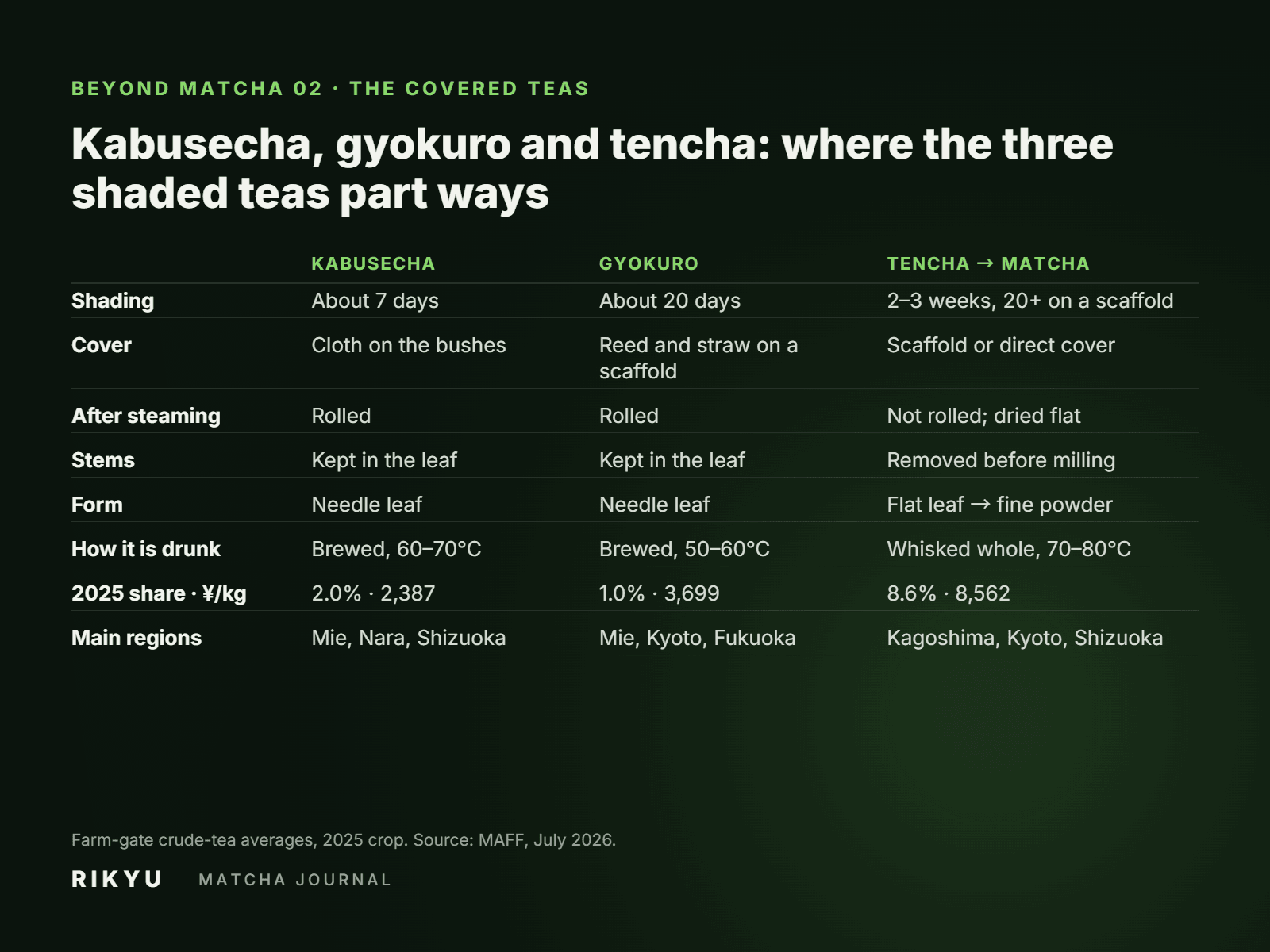
Kabusecha: shaded about 7 days under cloth laid directly on the bushes. Steamed and rolled. Halfway between sencha and gyokuro in taste. Mie grows 63% of Japan's supply.
Gyokuro: shaded about 20 days, traditionally under reed and straw on a scaffold. Steamed and rolled into needles. Brewed at low temperature for a thick, savoury cup. Mie, Kyoto and Fukuoka's Yame are the main regions.
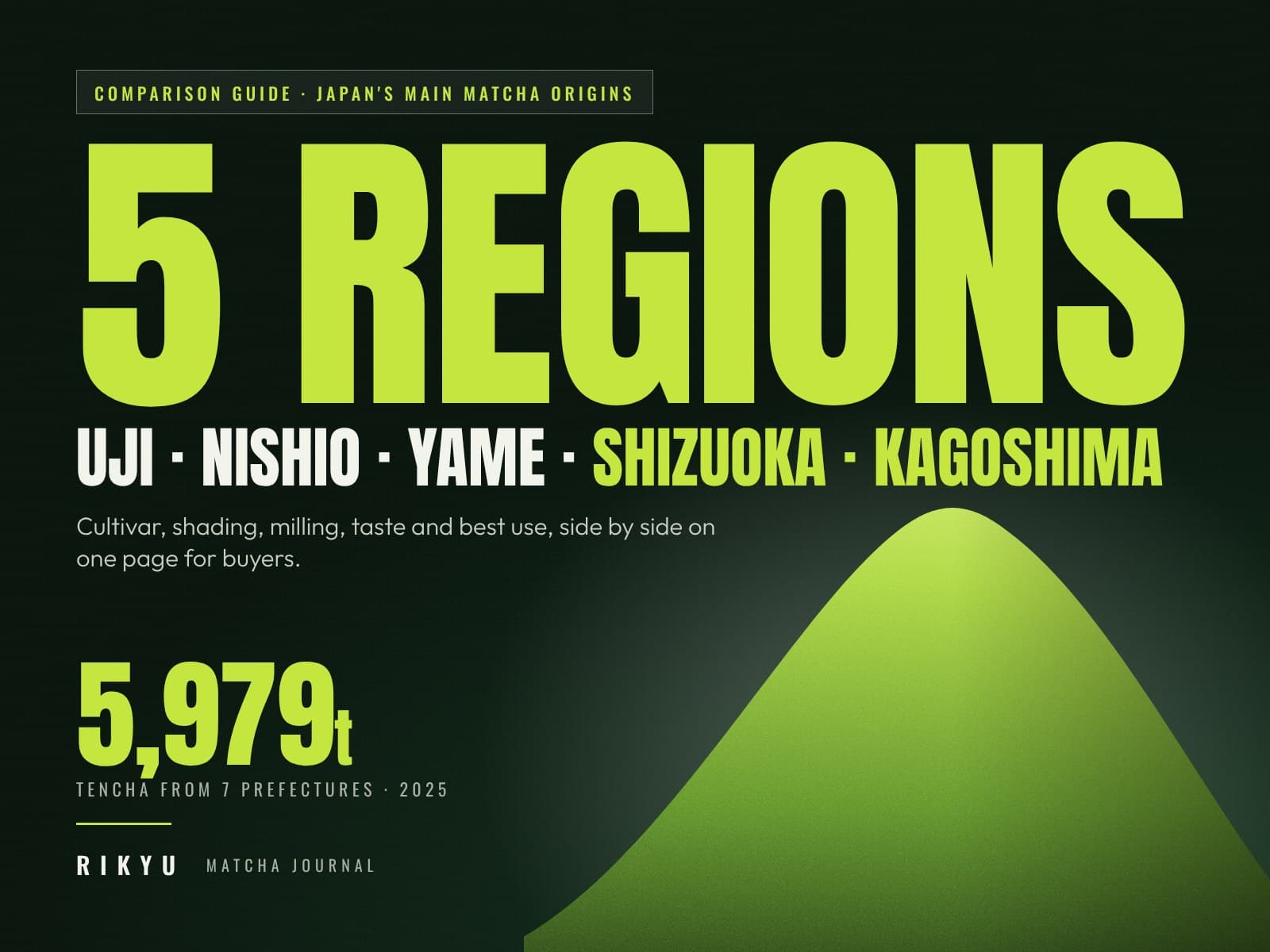
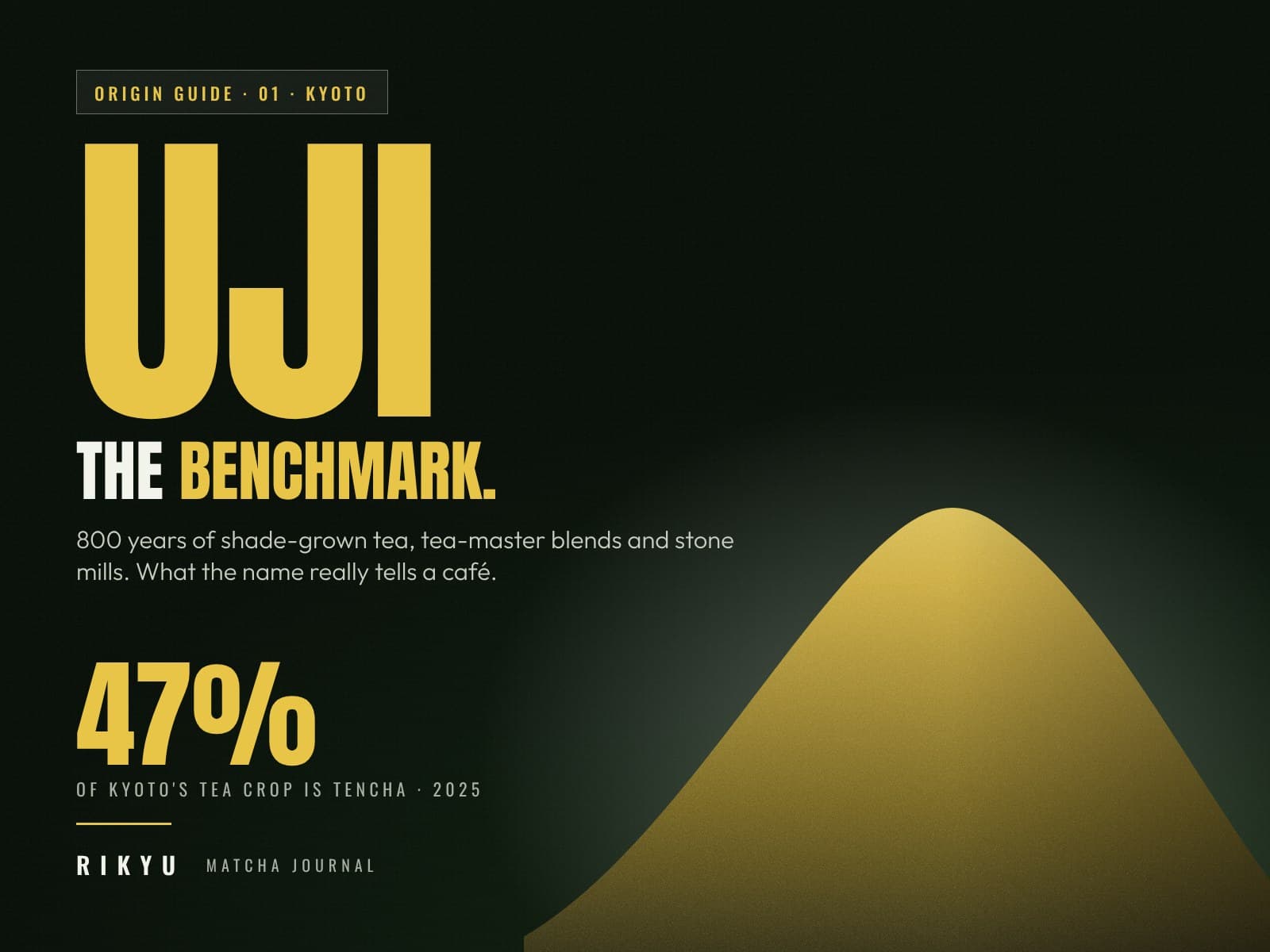
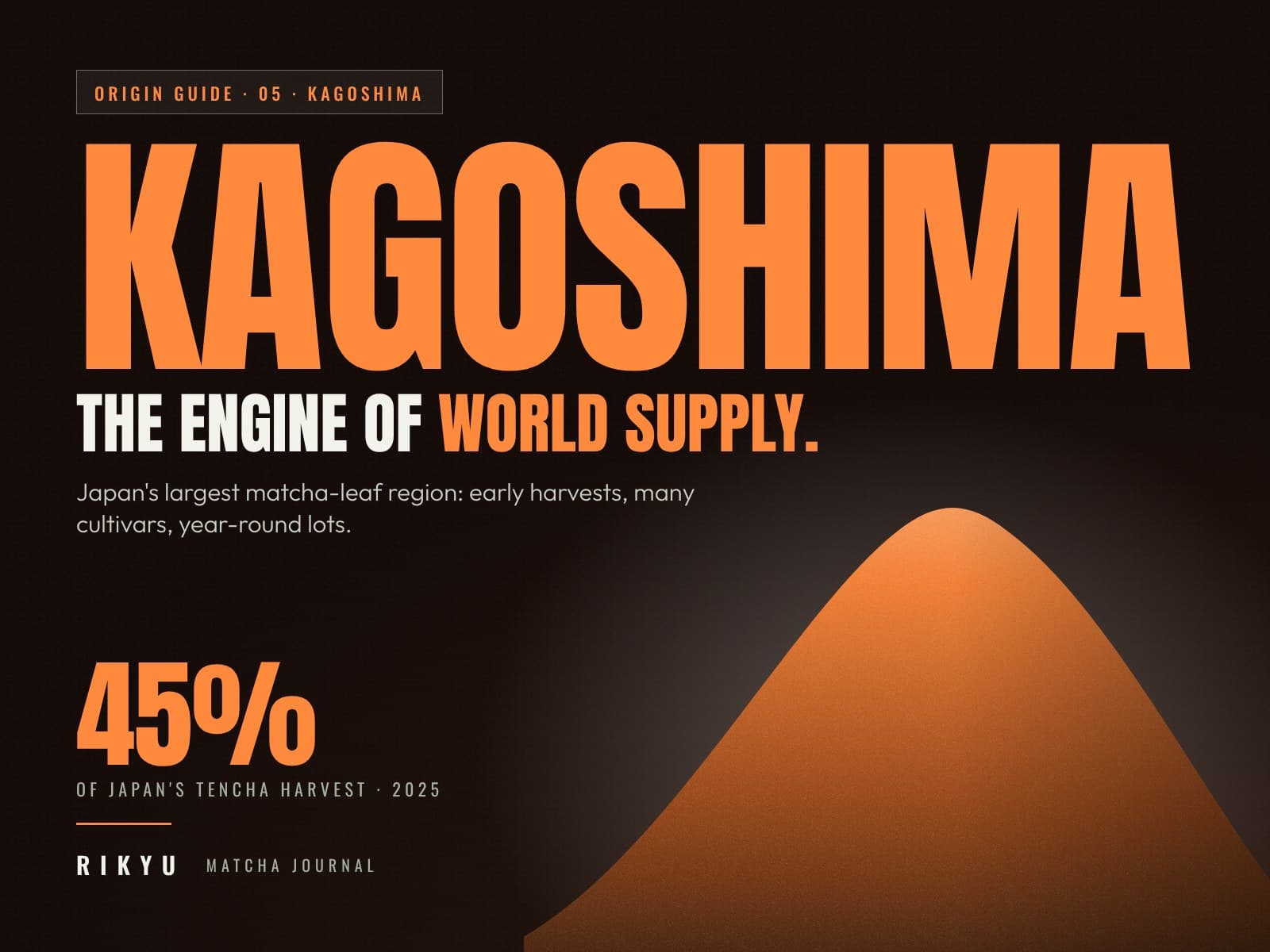
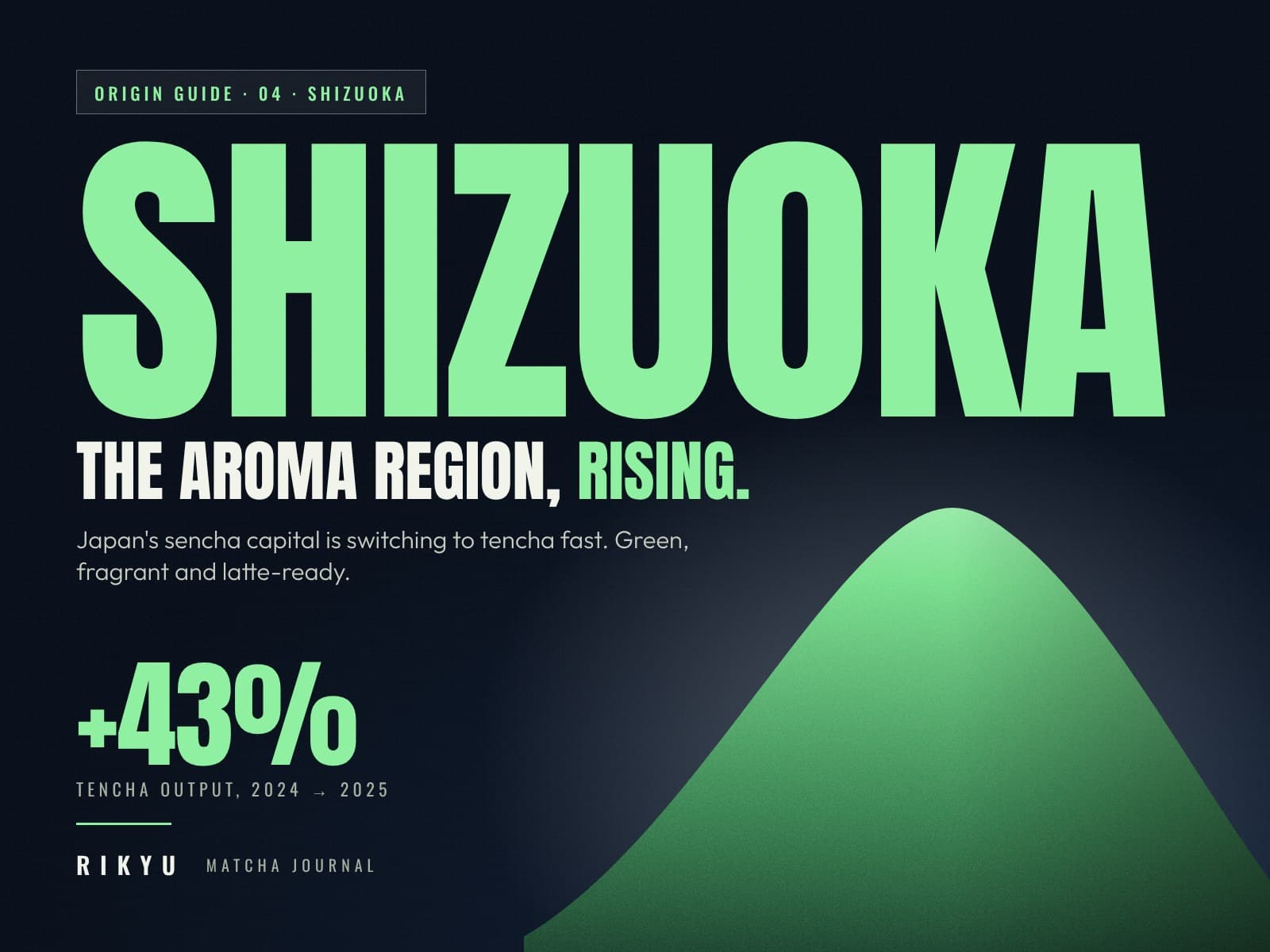
Tencha: shaded 2 to 3 weeks on a scaffold or under direct cover. Steamed, dried flat, never rolled, then destemmed. On its own it is a light, fragrant leaf; milled, it is matcha. Kagoshima now grows the most, followed by Kyoto and Shizuoka.
The shading itself does the same job in all three: it keeps theanine in the leaf instead of letting sunlight convert it to catechins, so the leaf comes out sweeter, less astringent and a deeper green. Our earlier article on tencha, gyokuro and kabusecha in Uji covers the shading methods in detail.
Why does rolling matter so much?
Rolling breaks the leaf's cell walls so that its compounds dissolve quickly in hot water. That is exactly what a brewed tea wants and exactly what a milled tea does not. Rolled leaf grinds into irregular, fibrous particles that feel coarse in the mouth and sink in the bowl. Flat, unrolled tencha is brittle, so it mills into particles a few microns across that stay suspended in water and milk. That is why matcha whisks to a foam and gyokuro powder does not, and why the stone mill, which grinds about 40 grams an hour, is reserved for tencha.
The same logic explains the stems. Gyokuro keeps its stems in the rolled leaf; they contribute sweetness to the brew. Tencha has its stems and veins removed before milling because they would turn the powder pale and gritty. The stems that come off the tencha line are sold as karigane, a stem tea prized for exactly the sweetness the matcha maker did not want.
What do the 2025 numbers say about tencha?
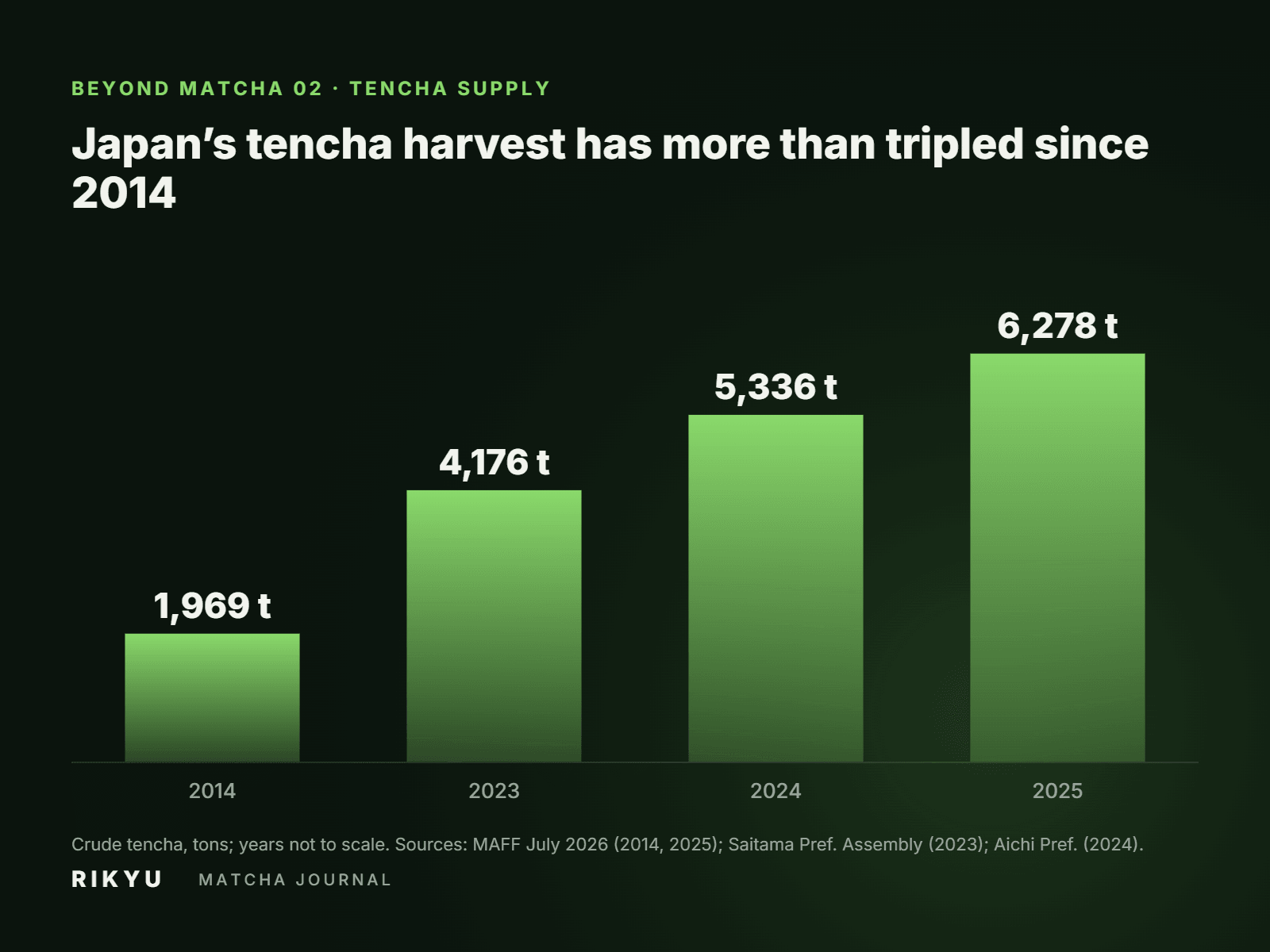
Japan grew 6,278 tons of tencha in 2025, about 3.2 times the 2014 figure and 8.6% of all crude tea. The average farm-gate price was ¥8,562 per kilo, 4.9 times the sencha average of ¥1,746. First-flush tencha fetched ¥10,030 per kilo, and the 2026 first flush traded at roughly twice the 2025 price in Kagoshima and 70% higher in Shizuoka. Gyokuro, by contrast, is 1.0% of output at ¥3,699 per kilo and is not growing. For a buyer the message is simple: matcha's raw material is the one Japanese tea whose supply is still racing to catch demand, and the price reflects it.
Related: Why US Cafés Are Asking for Price Lists in 2026 · Japanese Matcha Regions Compared
What does this mean for your café?
Treat “gyokuro powder” and “green tea powder” as different products from matcha. They can be good value for baking and blending, but they will not whisk, foam or colour a latte the way milled tencha does, and they should be priced and labelled accordingly.
Use grade words only for matcha. “Ceremonial” and “culinary” are matcha-trade terms. For gyokuro and kabusecha the quality axes are shading days, flush and region.
Ask for the three facts that define matcha. Shading days, whether the leaf was rolled, and whether it was stone- or machine-milled. A supplier who answers all three in writing is selling you matcha by definition, not by label.
Buy tencha-based matcha with the paperwork to prove it
Rikyu Matcha sources tencha directly from producers in Uji, Nishio, Yame, Shizuoka and Kagoshima, and every lot comes with a spec sheet stating shading method, flush and milling. Our SR series from Uji and KIKU from Kagoshima are stone-milled first-flush tencha; YMSC is a single-cultivar Yutakamidori from Kagoshima that fits latte programs and is pesticide-free. We can also supply unground tencha, and we offer a private label service in tins and pouches. Write to us with your volumes and how you will use the tea. We answer in English, from Tokyo, and we answer fast.
FAQ
What is tencha?
Tencha is shade-grown tea leaf that has been steamed and dried without rolling, then had its stems and veins removed. It is the raw material of matcha and is rarely sold for brewing.
Is gyokuro the same as matcha?
No. Both are shade-grown, but gyokuro is rolled and brewed as a leaf tea, while matcha is milled from unrolled tencha and consumed whole. Grinding gyokuro gives gyokuro powder, not matcha.
How many days is matcha leaf shaded?
Typically 2 to 3 weeks, and 20 days or more on a scaffold is the usual threshold for premium tencha. Some Uji producers shade 30 to 40 days for top grades.
Why is tencha so expensive?
Shading cuts yield and adds labour, tencha uses the best flushes, and demand has grown faster than planting. The 2025 average was ¥8,562/kg for tencha versus ¥1,746/kg for sencha.
Can matcha be made from sencha?
Not under the Japanese definition. Milled sencha is powdered green tea. It can be a useful ingredient but it is a different product with a different price.
Sources
Japan Tea Central Association, Green Tea Labelling Standard: definition of matcha (Japanese)
MAFF, “Cha wo meguru josei” (Situation of Tea), July 2026: tencha production, prices by type and flush, definitions used in export statistics (Japanese)
MAFF, Japanese tea reference for exporters: tencha and matcha processing, particle size (Japanese)
MAFF, tea situation report, September 2023: leading prefectures by tea type (Japanese)