Japanese Matcha Regions Compared: Uji, Nishio, Yame, Shizuoka and Kagoshima
24 October, 2026
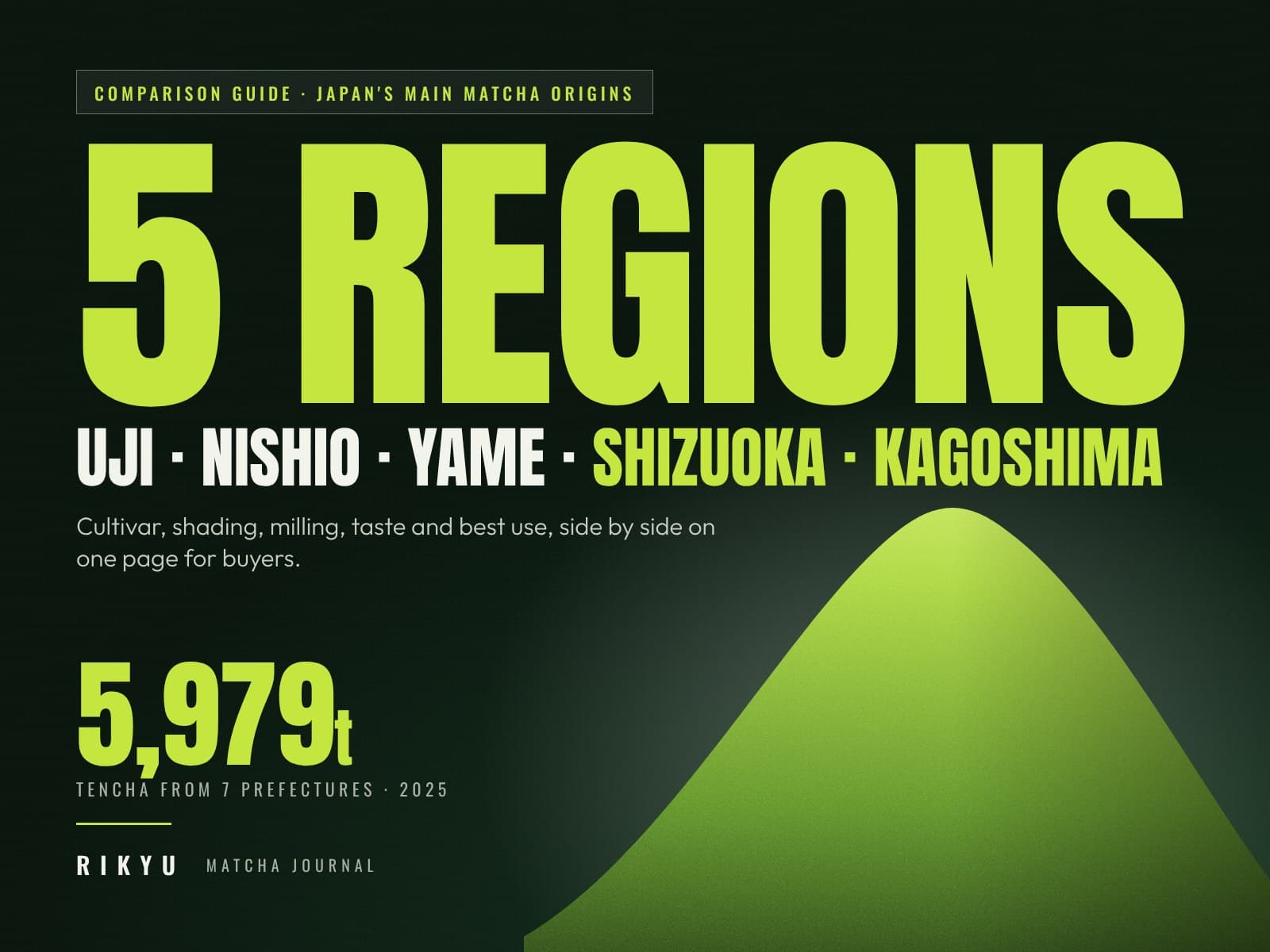
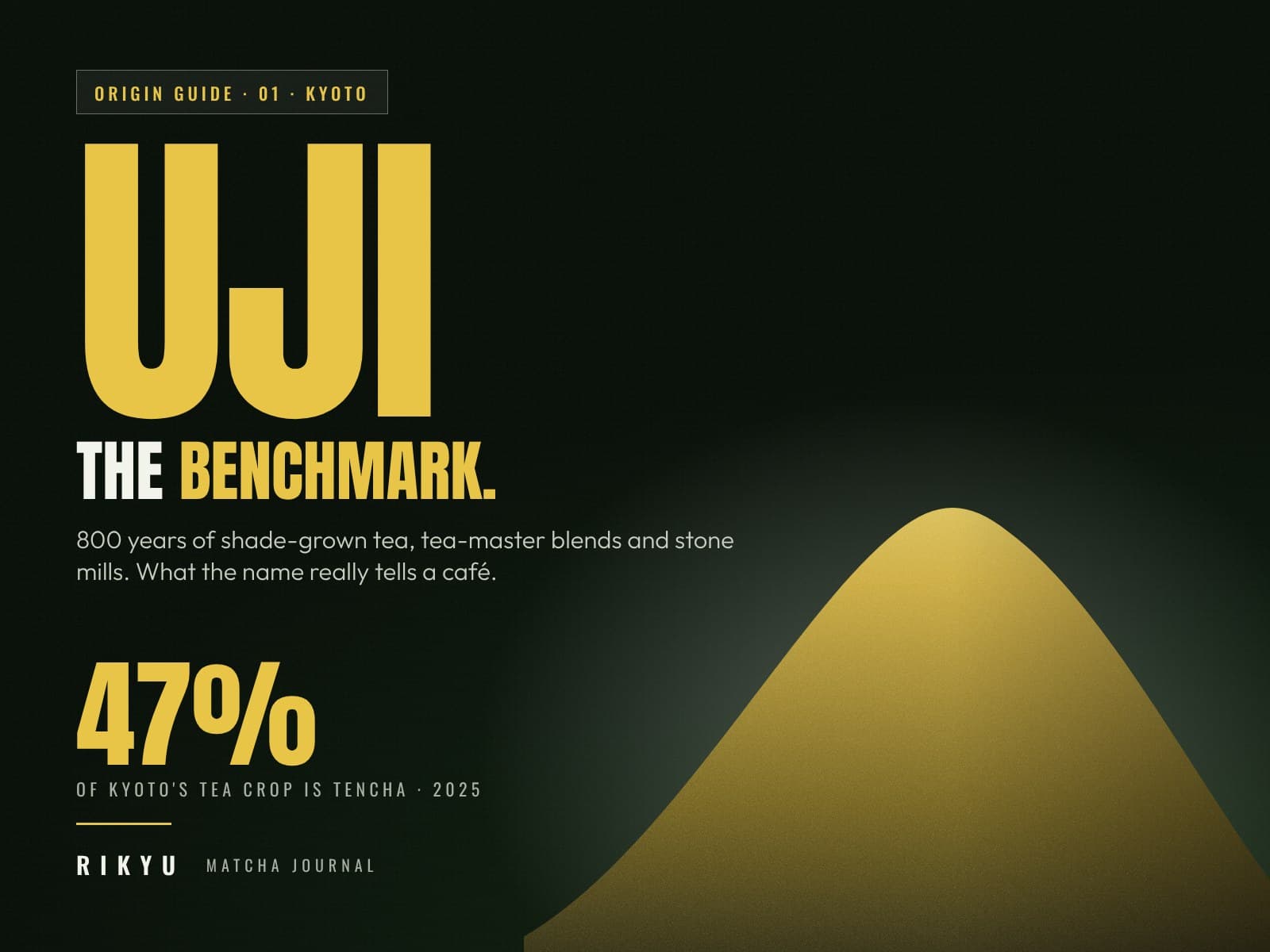
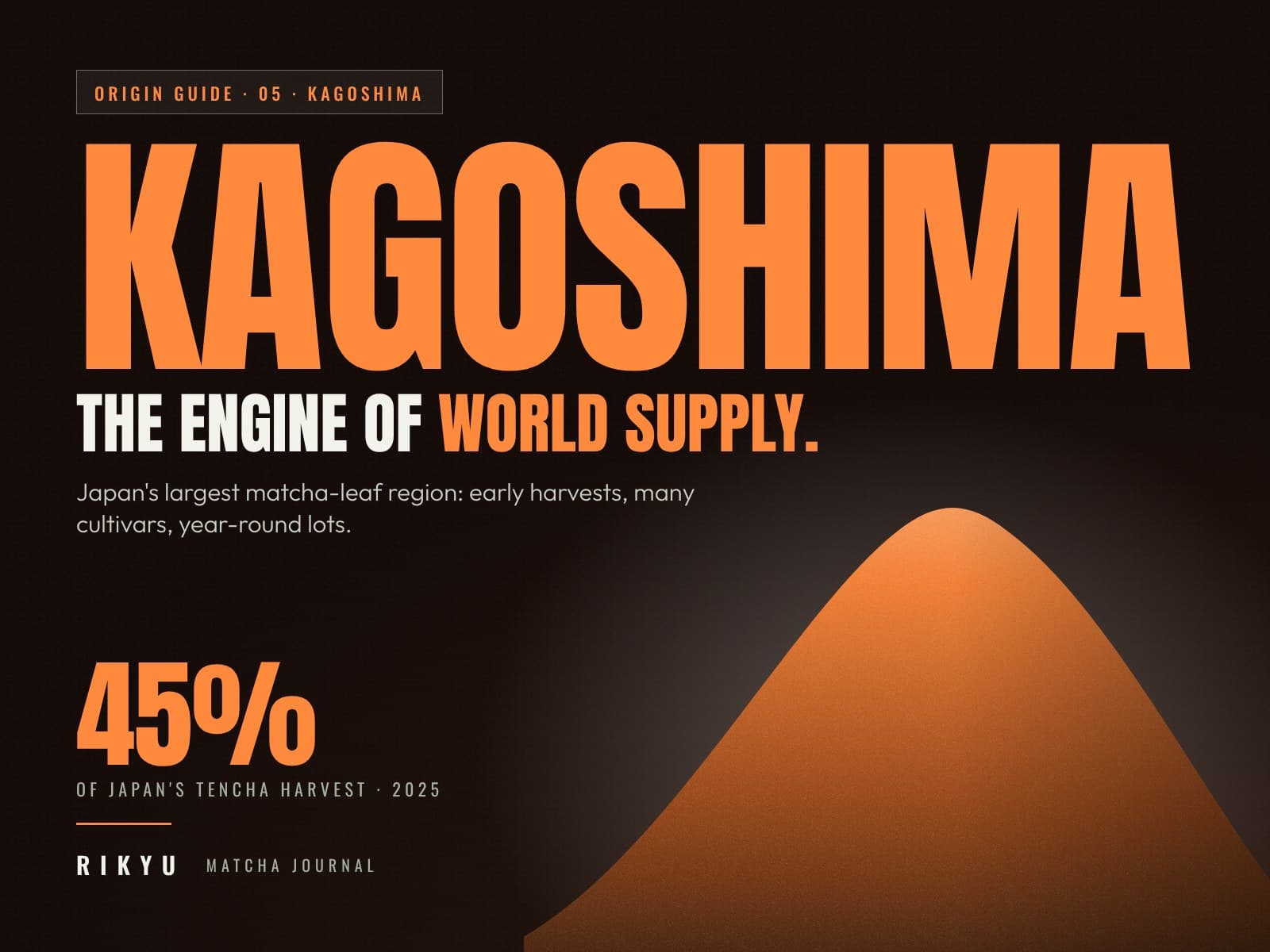
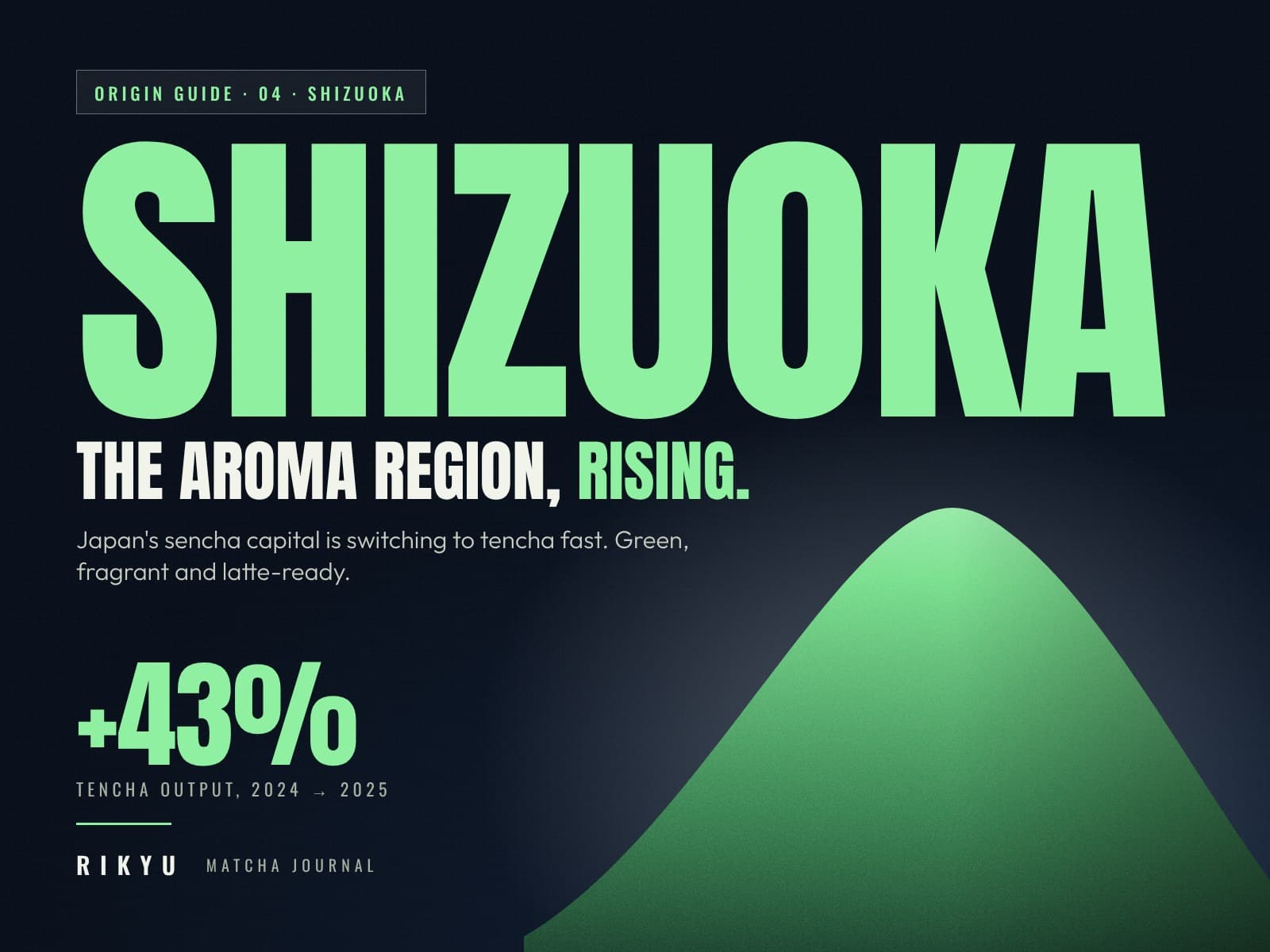
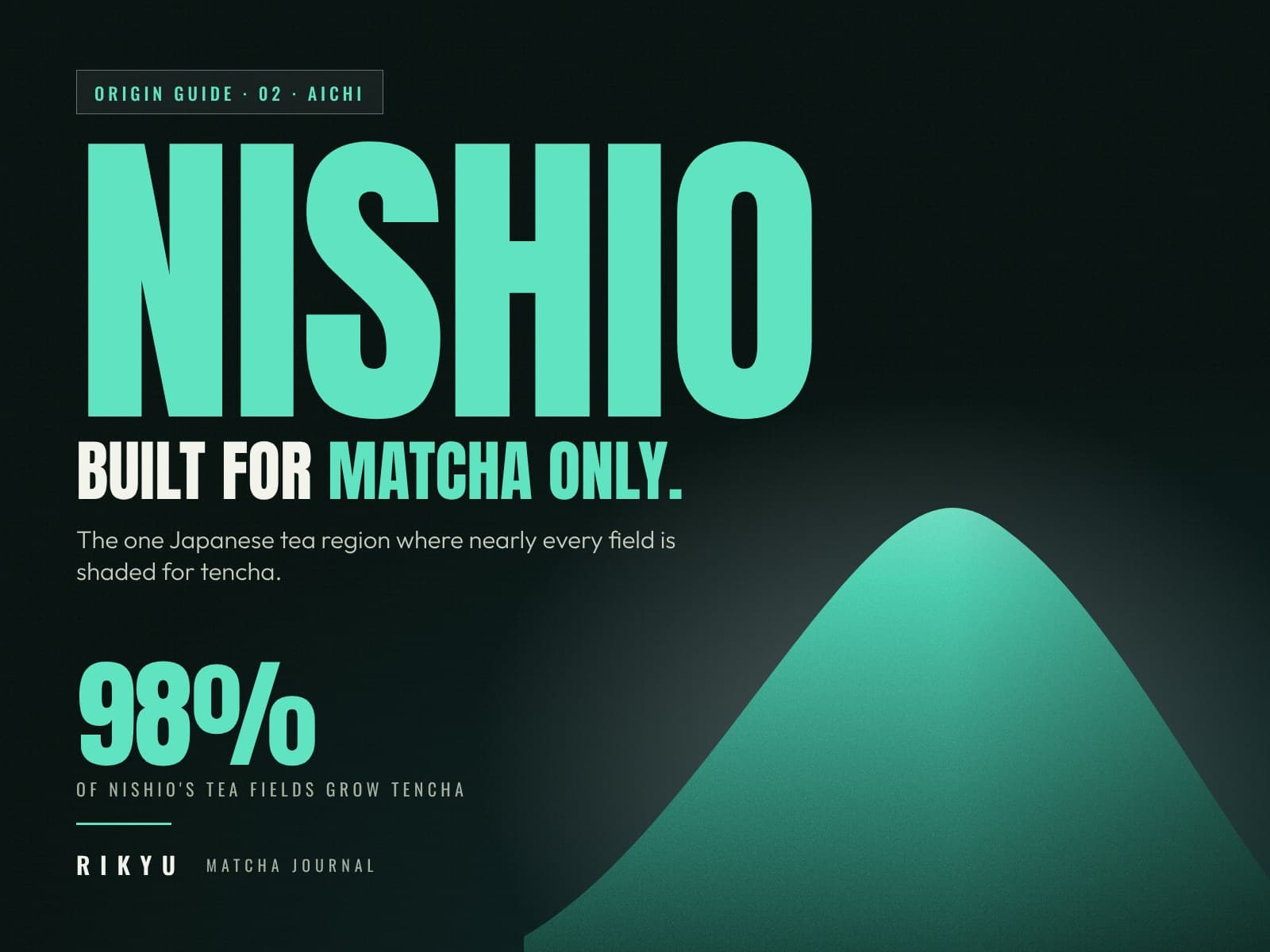
Japan has five main matcha regions, and they are not five versions of the same thing. Uji sets the standard, Nishio makes matcha and nothing else, Yame brings gyokuro-style sweetness, Shizuoka is the aroma region on the rise, and Kagoshima is the engine of world supply. This page puts them side by side on the points a buyer actually compares: where the leaf grows, how it is shaded, which cultivars are used, how it is milled, how it tastes, how much of it there is, and what it is best used for.
Each region has its own full guide: Uji, Nishio, Yame, Shizuoka and Kagoshima. This article is the summary.
How do the five regions compare at a glance?
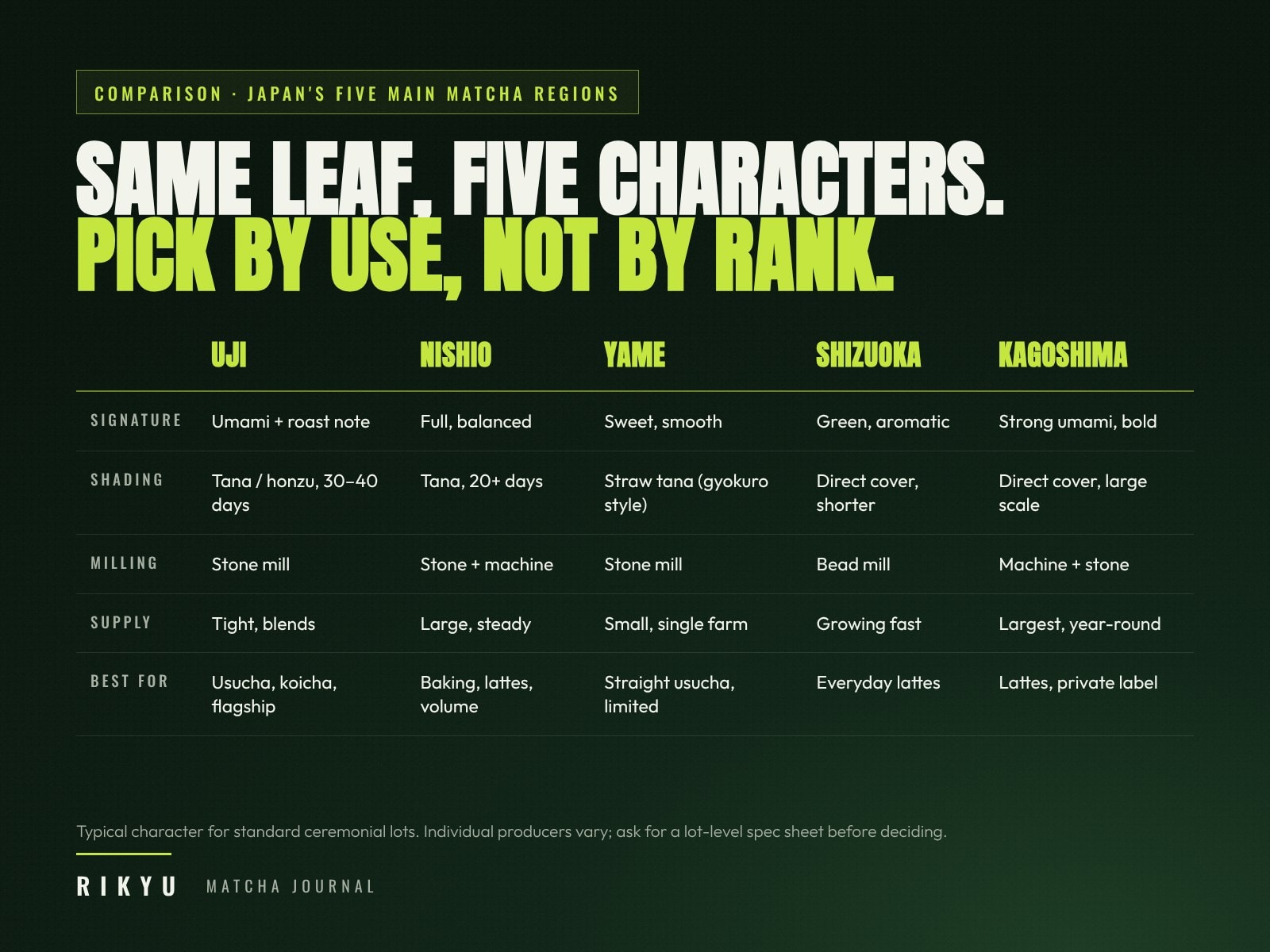
Table: typical character of a standard ceremonial lot from each region. Individual producers vary; the lot-level spec sheet is what you should decide on.
The same comparison, criterion by criterion:
Location
Uji: Southern Kyoto Prefecture: the Uji and Kizu river plains plus the hills of Wazuka, Ujitawara and Minamiyamashiro
Nishio: Nishio and Anjo, Aichi Prefecture, on the lower Yahagi River between Nagoya and the coast
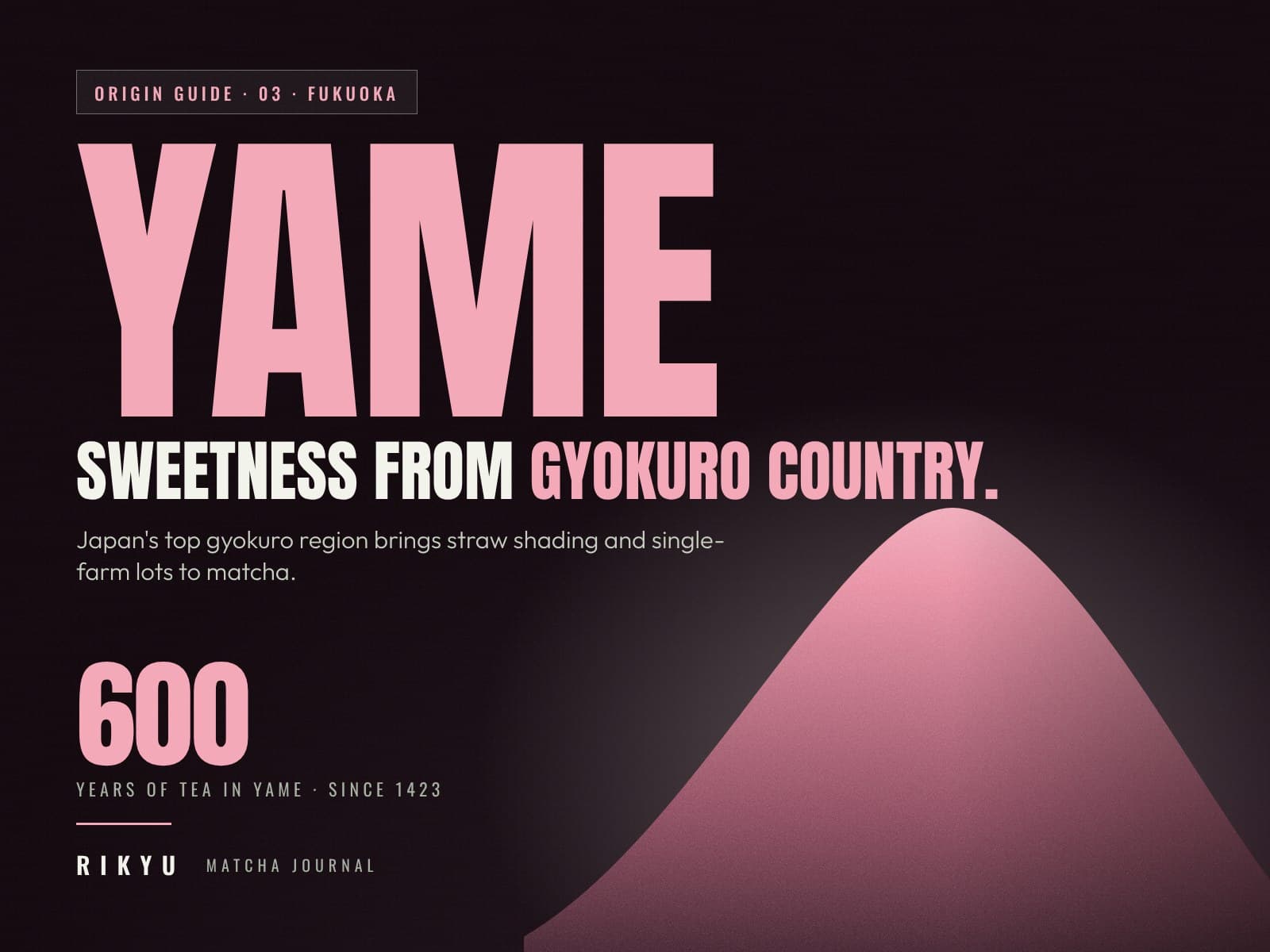
Yame: Southern Fukuoka Prefecture on Kyushu: the Yabe and Hoshino valleys around Yame City
Shizuoka: Across Shizuoka Prefecture: the Makinohara plateau, the Kawane and Honyama mountains, the Fujieda and Kakegawa hills
Kagoshima: Southern Kyushu: the Chiran, Ei, Kirishima, Shibushi and Osumi plateaus of Kagoshima Prefecture
Main cultivars
Uji: Asahi, Samidori, Ujihikari, Gokou, Okumidori, Yabukita
Nishio: Samidori, Yabukita, Okumidori, Gokou lines
Yame: Yabukita, Saemidori, Okumidori
Shizuoka: Yabukita above all; Saemidori, Tsuyuhikari and Okumidori being planted
Kagoshima: Yutakamidori, Saemidori, Asatsuyu, Okumidori, Asanoka and more
Shading
Uji: Scaffold (tana) shading 30 to 40 days; reed-and-straw honzu for top grades
Nishio: Scaffold shading of 20 or more days from first flush, the local definition of Nishio matcha
Yame: Rice-straw scaffold shading inherited from gyokuro, with cloth and some direct cover
Shizuoka: Mostly direct cover and shorter periods; scaffold shading is limited
Kagoshima: Direct cover across large estates by machine; scaffold shading for premium lines
Processing and milling
Uji: Brick tencha kilns, slightly firmer firing (the roasted hika note); stone mills for top grades
Nishio: Large refiners with banks of stone mills; machine mills for food grade
Yame: Stone mills; gentle firing that keeps the leaf's sweet aroma
Shizuoka: Converted sencha lines; light firing; bead mills and other machine milling
Kagoshima: Large tencha factories; machine milling for volume, stone for premium; unground tencha available
Taste
Uji: Umami, sweetness and color all high, defined by a light roast; long finish at the top grades
Nishio: Orthodox and even, slightly fuller body, gentle bitterness; survives milk, sugar and heat
Yame: Sweet, soft umami, very low bitterness; the easiest first matcha
Shizuoka: Most aromatic and vegetal; balanced umami and sweetness; some lots a touch bitter
Kagoshima: Strong umami, deep green, moderate bitterness; direct, shorter finish; does not vanish in milk
Supply and 2025 tencha harvest
Uji: 989 t (down from 1,068 t); tight, prices rising, products are tea-master blends
Nishio: 463 t (up from 428 t); large and steady, organic lines
Yame: 280 t (up from 192 t); the smallest, single-farm lots, demand ahead of supply
Shizuoka: 875 t (up from 611 t, +43%); growing fastest
Kagoshima: 2,670 t (up from 2,150 t); the largest at about 45% of Japan, same spec year-round
Best for
Uji: Straight usucha and koicha, a flagship menu item, gifting
Nishio: Baking, ice cream, high-volume lattes, food-manufacturer supply
Yame: Straight usucha, first-time drinkers, limited and seasonal lines
Shizuoka: Everyday café lattes, organic programs, price-sensitive menus
Kagoshima: Lattes, private label, organic and EU or US compliant programs
RIKYU products
Uji: SR-8 (Okumidori blend, stone-milled), SR-5 (Yabukita blend, for milk), more SR grades in the catalogue
Nishio: AKOG (Yabukita blend, stone-milled, organic)
Yame: YAME 1 (Okumidori and Yabukita, stone-milled), YAME 2, YAME 3 (single cultivar)
Shizuoka: SHIZUOKA A (Okumidori, Yabukita and Tsuyuhikari), SHIZUOKA B (organic), SHIZUOKA C
Kagoshima: YMSC (Yutakamidori single, pesticide-free), KIKU (Okumidori single, stone-milled)
Where is Japan's matcha leaf grown now?
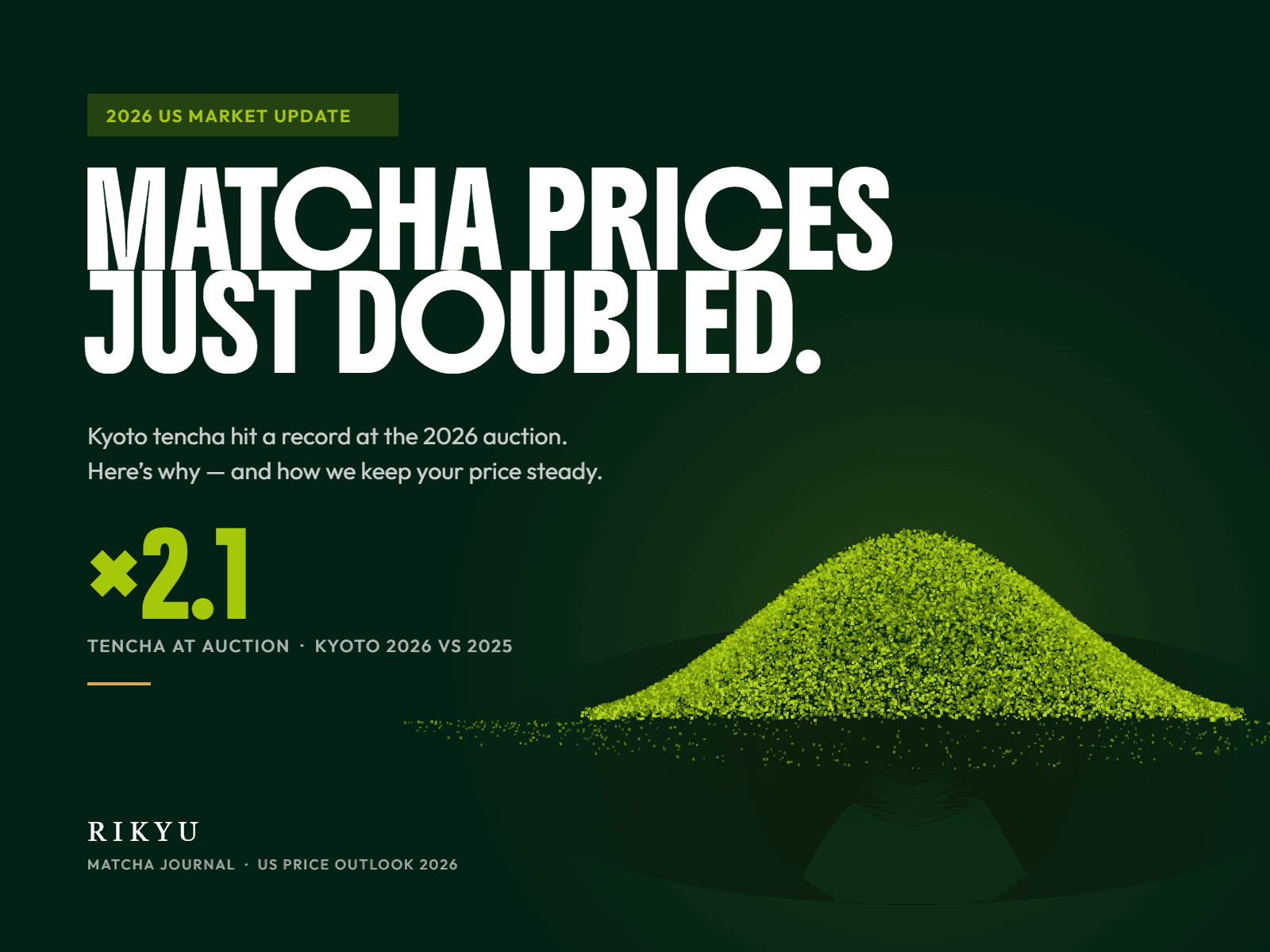
The center of gravity has moved. In 2012 Kyoto and Aichi together grew close to 80% of Japan's tencha. Sencha regions then converted, and in 2025 Kagoshima alone grew more than 40%. Kyoto's harvest fell from 1,068 tons in 2024 to 989 tons in 2025, Shizuoka's rose 43%, and Kagoshima's rose 24%. The price rises on Uji matcha, and the recipe changes to some long-standing Uji products, come from this shift.
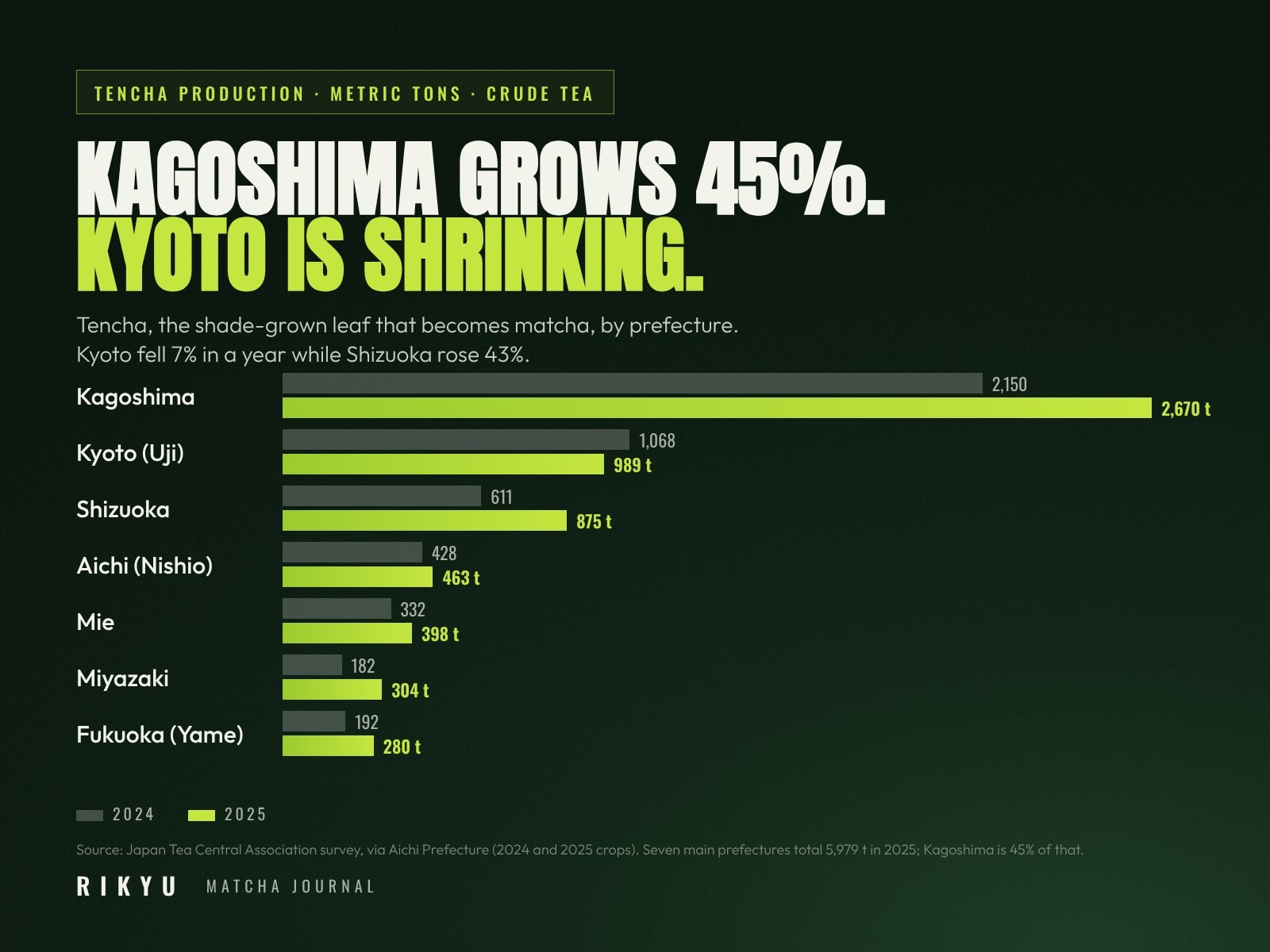
Chart: tencha (crude tea) production by prefecture, 2024 and 2025 crops. Source: Japan Tea Central Association survey via Aichi Prefecture. The seven main prefectures total 5,979 tons in 2025, of which Kagoshima is 45%.
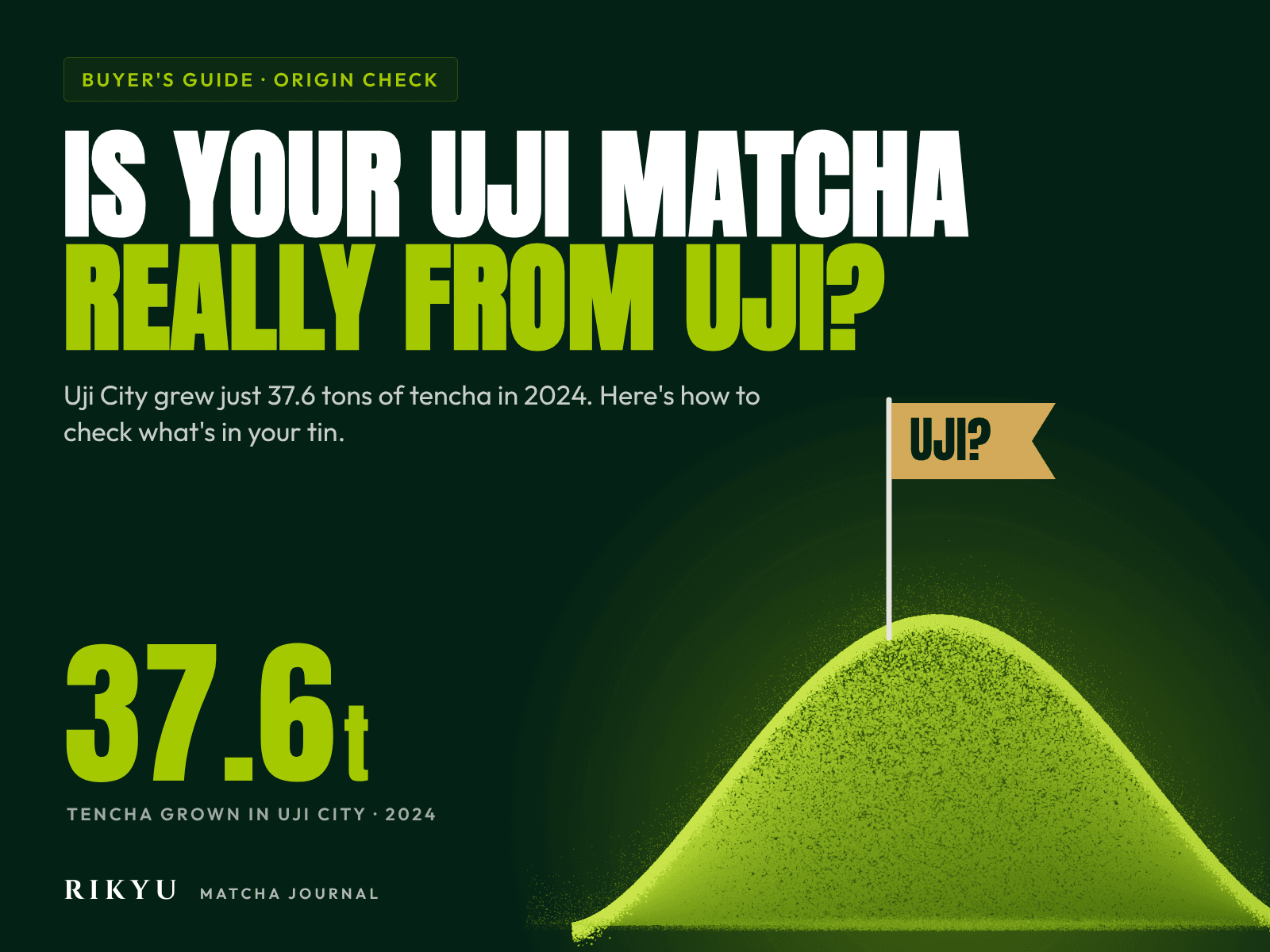
Related: Why US Cafés Are Asking for Price Lists in 2026 · Is Your Uji Matcha Really from Uji?
What are the five things that make regions taste different?
Regional differences in matcha are less about where the leaf grew than about how it was grown and milled. Five variables explain most of what you taste and most of what you pay.
Climate and terrain. Fog, day-night temperature swings and river valleys slow leaf growth and keep theanine (umami) in the leaf. Warm, flat regions win on yield and early harvests.
Shading method and length. Scaffold shading (tana, or reed-and-straw honzu) versus cloth draped directly on the bushes. Twenty or more days on a scaffold is the usual threshold for premium tencha, and it changes cost as much as quality.
Cultivar. Yabukita (aroma, versatility); the Uji natives Samidori, Asahi and Ujihikari (deep umami); Okumidori (late, vivid green); Yutakamidori and Saemidori (Kagoshima's early cultivars, color and body).
Processing and milling. Firing in the tencha kiln (roast note or not) and stone mill versus machine mill. A stone mill grinds about 40 grams an hour, which is why it shows up in the price.
Distribution and blending culture. Regions where tea masters blend for consistency (Uji) versus regions where single-farm, single-cultivar lots are natural (Yame, Kagoshima). This decides how you can answer a “single origin” request.
Related: Single Estate vs. Single Origin vs. Single Cultivar · First Harvest vs. Second Harvest
Which region should a café buy?
Do not rank them. Uji is the standard, Kagoshima and Shizuoka are supply, Yame and Nishio are character. A practical lineup for most cafés is one flagship and one workhorse: Uji (or Yame) for straight matcha on the menu, Kagoshima or Shizuoka for the lattes that make up most of the volume. Cafés that bake add Nishio. Cafés that want a single-cultivar story go to Yame or Kagoshima. For EU buyers, remember that pesticide (MRL) compliance is a property of the lot, not of the region: ask for residue results for every lot, whatever its origin.
Smaller regions also appear on spec sheets. Mie (398 t in 2025) is Japan's biggest kabusecha region and a long-standing source of leaf for Uji tea blends. Nara's Yamato highlands, at 300 to 500 meters, grow cold-climate, umami-rich tencha that falls within the Uji tea definition. Miyazaki (304 t, up 1.7 times) borders Kagoshima and behaves like a Kyushu supply line. Sayama in Saitama is not a matcha region, but its strongly fired leaf makes an excellent hojicha, which is where our ARIHOJ hojicha powder comes from.
Related: Finding the Perfect Matcha for Your Business · RIKYU Hojicha for Cafés
Buy from the region that fits your menu
Rikyu Matcha is based in Tokyo and sources matcha directly from producers in Uji, Nishio, Yame, Shizuoka and Kagoshima. Every lot comes with a spec sheet, and we can provide a certificate of origin, a certificate of analysis (COA) and pesticide residue test results on request. If you are deciding between regions for a latte program, a straight-matcha menu or a private label, write to us with your volumes and how you will use it. We answer in English, from Tokyo, and we answer fast.
FAQ
What are the main matcha regions in Japan?
Uji (Kyoto), Nishio (Aichi), Yame (Fukuoka), Shizuoka and Kagoshima. Mie, Nara and Miyazaki also grow tencha, mostly as blending or supply regions.
Which region produces the most matcha?
Kagoshima, with 2,670 tons of tencha in 2025, about 45% of Japan's harvest. Kyoto is second at 989 tons and Shizuoka third at 875 tons.
Which region has the best matcha?
Uji sets the reference at the top end, especially for koicha. For lattes, Kagoshima and Shizuoka usually fit better; for sweetness, Yame; for baking and volume, Nishio. Choose by use.
Which region is best for matcha lattes?
Kagoshima for umami and color that hold up in milk, Shizuoka for aroma and price, Nishio for body and heat stability. Uji's top grades are better drunk straight.
Is matcha from one region always EU compliant?
No. Pesticide residue (MRL) compliance is decided lot by lot. Kagoshima and parts of Shizuoka have the most compliant producers, but always ask for the test results for your lot.
Sources
Japan Tea Central Association, tencha production by prefecture, 2024 and 2025 crops (via Aichi Prefecture, Japanese)
Nagasaki Customs, special report on Kagoshima green tea exports (October 2025, Japanese)
BCN, crude tea production ranking for the 2024 crop (Japanese)
Jiji Press, Nishio matcha and its GI withdrawal (2020, Japanese)
Regional brand information design study on the shift in tencha production share (Japanese)
Historical and horticultural details reflect standard Japanese tea-industry references; we recommend confirming specific claims with each region's supplier before reuse.