Nishio Matcha: Japan's Matcha-Only Region, Explained
24 October, 2026
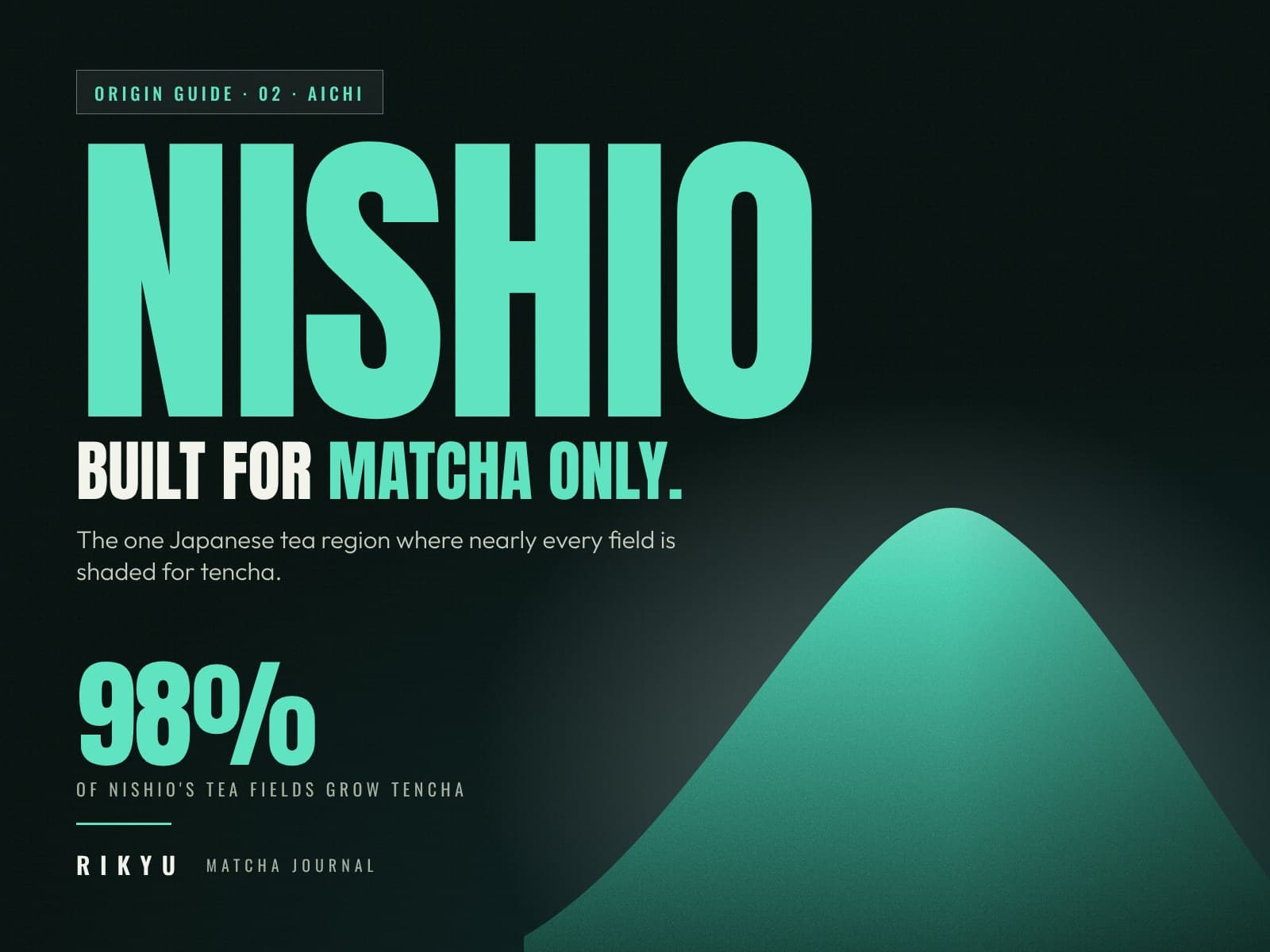
Nishio, in Aichi Prefecture between Nagoya and the Pacific coast, is the only tea region in Japan that makes almost nothing but matcha. Around 96 to 98% of its tea fields grow shaded tencha, and the whole production chain, from the field to the refiner to the mill, has been tuned to matcha for a century and a half. This guide explains how Nishio got there, what its matcha tastes like, and why food manufacturers and latte-heavy cafés so often end up buying it.
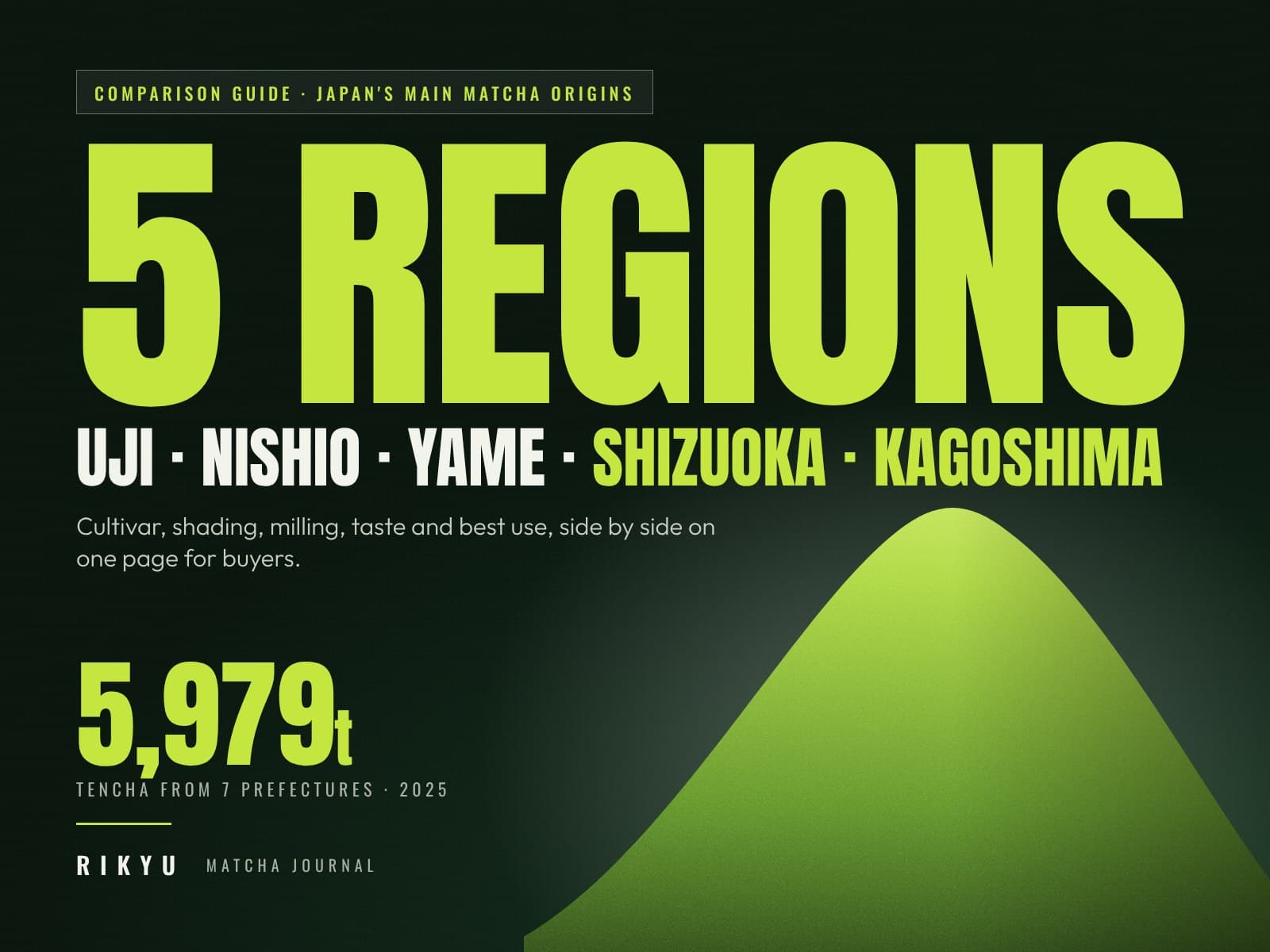
This is the second of five origin guides, after Uji. The others cover Yame, Shizuoka and Kagoshima, and a comparison table puts all five side by side.
How did Nishio become a matcha-only region?
Tea is said to have arrived in 1271, when the founding priest of Jissoji temple, Shoichi Kokushi, planted seeds in the area. Commercial tea growing began in the early Meiji era, around 1872, when Adachi Jundo, the head priest of Koujuin temple, brought tea seed and know-how back from Uji. From the start Nishio set out to learn from Uji and stand beside it.
Three local conditions pushed the region toward tencha specifically. The alluvial soil of the lower Yahagi River is fertile and well drained; the climate is mild and relatively free of typhoon and heavy-rain damage; and the big consumer markets of Nagoya and Okazaki were close by. Tencha also needs less equipment than sencha because the leaf is not rolled, which made it easier for small growers to enter.
In 2009 “Nishio no Matcha” was registered as a regional collective trademark, and in 2017 it became the first matcha in Japan to receive Geographical Indication (GI) protection. In 2020 the producers' association itself withdrew the GI, the first withdrawal since the system was created, because the GI's requirement of at least 25 days of scaffold shading tied the name to the premium end and left no room for the region's large food-grade business. That decision tells you what Nishio is: a region that lives on both high-grade and processing-grade matcha, and is honest about it.
What is the Nishio terroir?
Flat land along the Yahagi River with rich, free-draining alluvial soil, a warm coastal climate, and little weather damage. The flatness matters more than it sounds: scaffold (tana) shading is far easier to build and manage on level fields, and Nishio has kept the tana tradition as its standard rather than switching wholesale to direct covering.
The local definition of Nishio matcha is tencha shaded on a scaffold for at least 20 days from the first flush in April (the former GI standard was 25 days). Direct covering is less labor, but letting the leaf grow naturally under a scaffold deepens both color and umami. Aichi Prefecture has even developed an image-analysis method that uses the leaf's green-red value to tell scaffold-shaded tencha from direct-covered tencha, which shows how central scaffold shading is to the region's idea of quality.
Which cultivars does Nishio grow?
Samidori, Yabukita and Okumidori lead, together with Nishio's own lines of the Gokou cultivar. Samidori is a classic tencha cultivar with strong umami and a bright green color, and it is the one most associated with the region's drinking grades.
How is Nishio matcha milled?
Nishio is home to several of Japan's largest matcha refiners, with banks of stone mills running in parallel. A large share of the food-grade matcha used by Japanese confectionery, ice-cream and beverage makers is milled here. The region has also led in developing heat-stable matcha (with no additives) that keeps its green color in baked goods and ice cream, which is why “matcha as a food ingredient” is more advanced in Nishio than anywhere else.
Inside the region, the division of labor is clear: scaffold-shaded, stone-milled tencha for drinking grades; direct-covered, machine-milled tencha for processing grades. Both are made well, and both are sold as Nishio matcha.
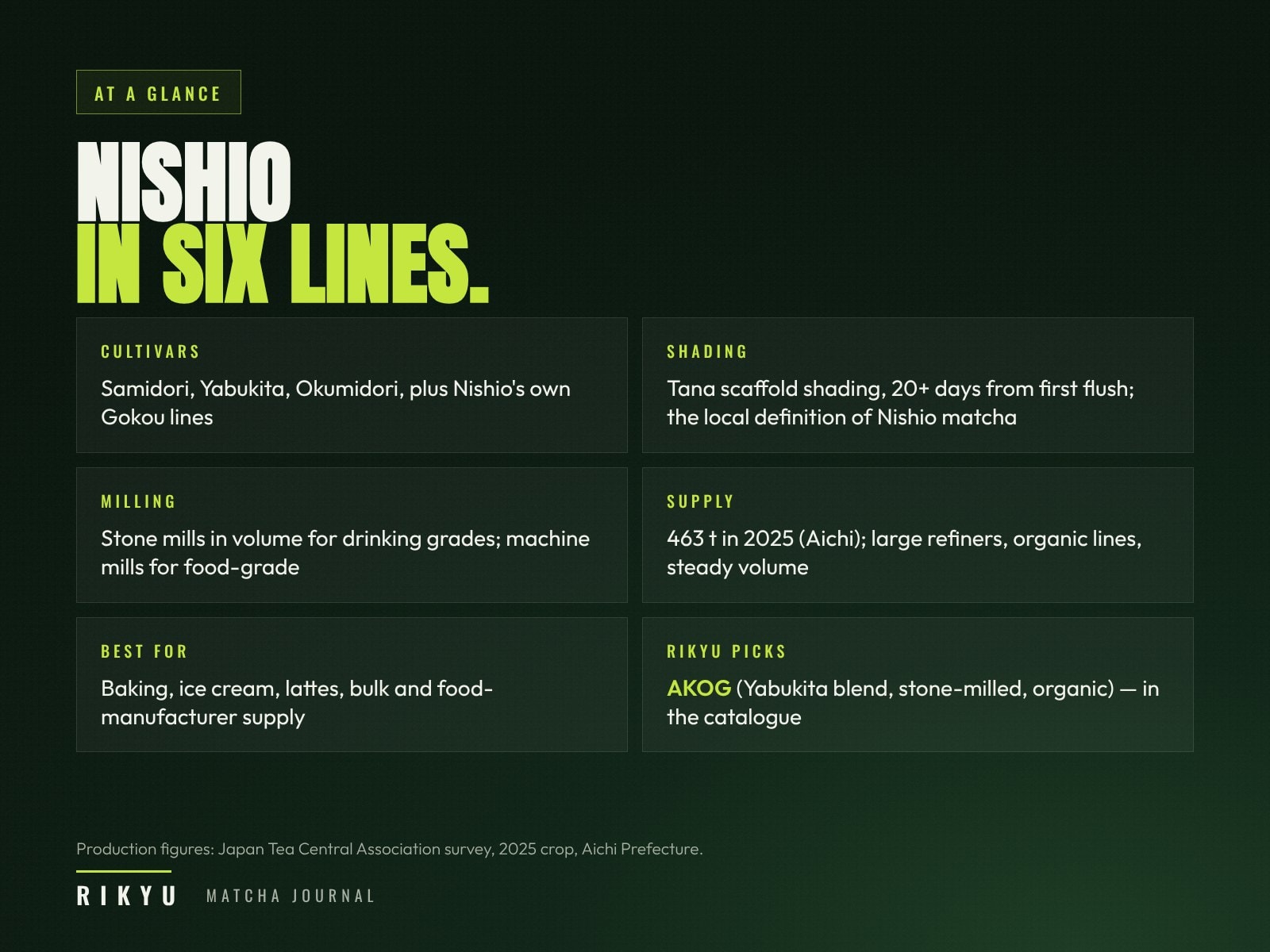
Card: Nishio matcha in six lines. Production figure is the 2025 Aichi Prefecture tencha crop.
What does Nishio matcha taste like?
Orthodox and even. Compared with Uji it is slightly fuller in body, the bitterness is gentle, and umami and sweetness are in balance. It has no strong signature note to divide opinion, which is exactly why it works so well with milk, sugar and heat: the matcha is still clearly there in a latte, a cookie or a soft-serve. If Uji is the connoisseur's reference, Nishio is the safe correct answer for a broad audience.
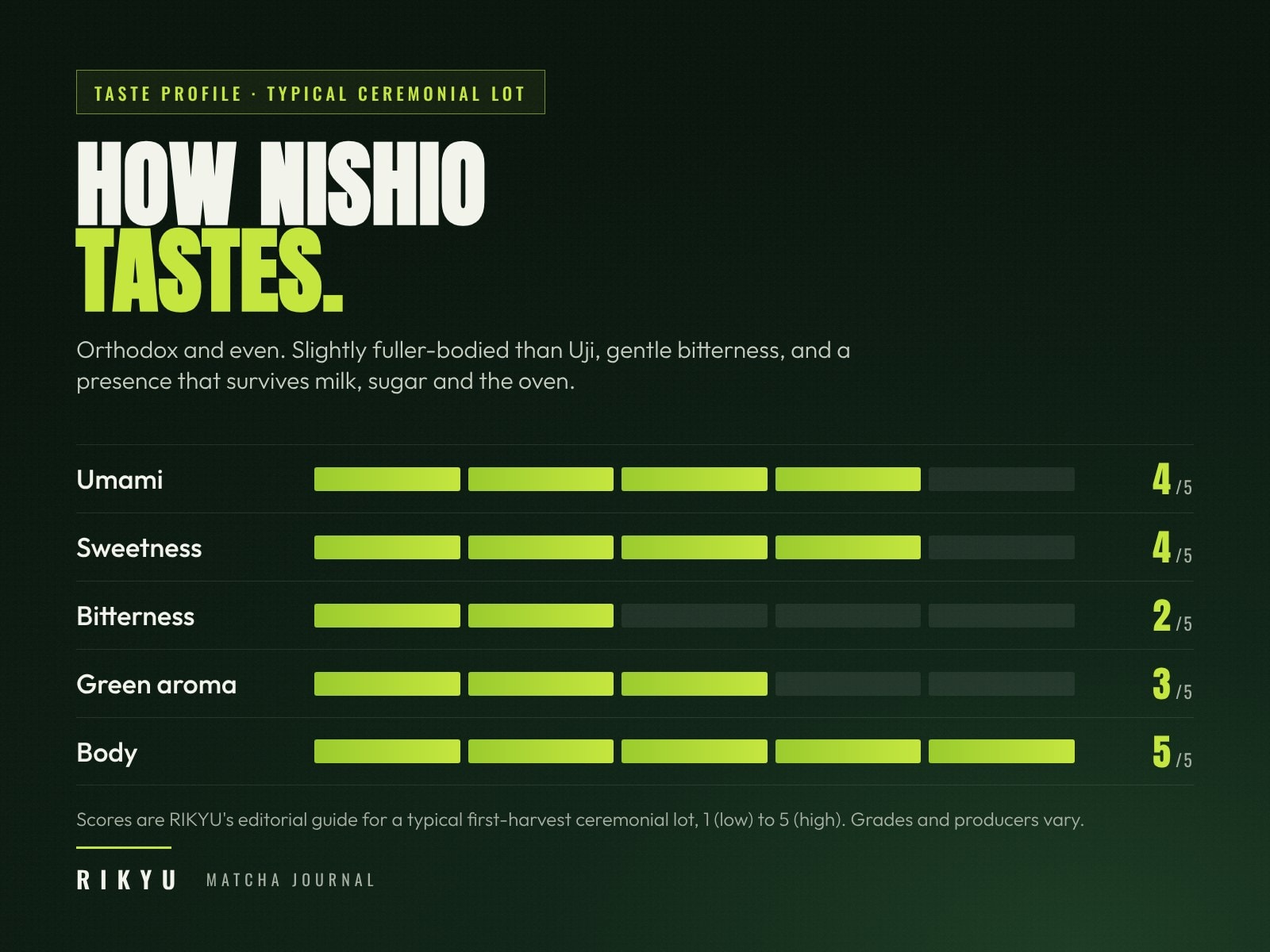
Chart: RIKYU's editorial taste profile for a typical first-harvest Nishio ceremonial lot. Individual products vary.
How does Nishio fit an overseas café?
Inside Japan, Nishio is known as the king of processing-grade matcha; overseas, its name recognition is far below Uji's. The producers' association has filed trademarks in nine countries including the United States, China and Thailand, as well as Hong Kong and Taiwan, and has opposed Chinese applications for “Nishio matcha,” so the region is actively defending its name abroad.
For a buyer, Nishio's strengths are consistency and volume. It is the natural choice for a café that bakes with matcha, runs a high-volume latte menu, or supplies a food manufacturer. Organic lines exist, and some lots meet EU pesticide limits, but as with every region, MRL compliance is decided lot by lot: ask for the residue test results for the exact lot you are buying rather than relying on the region's name.
Aichi's tencha crop was 463 tons in 2025, fourth in Japan, up slightly from 428 tons in 2024. Sencha from the same prefecture was only 64 tons, which shows how completely the region has committed to matcha.
Related: First, Second and Third Harvest Matcha · Finding the Perfect Matcha for Your Business
Which RIKYU products come from Nishio?
Our Nishio product is AKOG, a stone-milled Yabukita blend from organic farming. It is the one we recommend when a customer wants an orthodox, crowd-pleasing profile for lattes and baking with an organic story behind it. Details, MOQs and current lots are in the catalogue.
Buy from the region that fits your menu
Rikyu Matcha is based in Tokyo and sources matcha directly from producers in Uji, Nishio, Yame, Shizuoka and Kagoshima. Every lot comes with a spec sheet, and we can provide a certificate of origin, a certificate of analysis (COA) and pesticide residue test results on request. If you are deciding between regions for a latte program, a straight-matcha menu or a private label, write to us with your volumes and how you will use it. We answer in English, from Tokyo, and we answer fast.
FAQ
What is Nishio matcha?
Matcha from Nishio and Anjo in Aichi Prefecture, Japan's only region where almost all tea fields grow shaded tencha for matcha. The local standard is scaffold shading of at least 20 days from the first flush.
Is Nishio matcha good quality?
Yes. Nishio makes both high drinking grades and the bulk of Japan's food-grade matcha. It is known for balance and for holding its flavor and color in milk and in baking.
Why did Nishio give up its GI registration?
The GI required at least 25 days of scaffold shading, which tied the name to premium tencha only. The producers withdrew in 2020 so that the region's large processing-grade business could keep using the Nishio name.
Is Nishio matcha organic?
Some lines are, including RIKYU's AKOG. Organic certification and pesticide residue results are specific to each lot and producer, so ask for documents for the lot you are buying.
Uji or Nishio for a latte?
Nishio, in most cases. Its fuller body and even profile keep the matcha present in milk. Uji's top grades are better spent on straight matcha.
Sources
Japan Tea Central Association, tencha production by prefecture, 2024 and 2025 crops (via Aichi Prefecture, Japanese)
Jiji Press, Nishio matcha and the withdrawal of its GI registration (2020, Japanese)
Business Insider Japan, Nishio matcha overseas trademarks and regional competition (Japanese)
Aichi Prefecture, image-analysis method for distinguishing scaffold-shaded tencha (Japanese)
Nishio Tea Cooperative, history and definition of Nishio matcha (Japanese)
Historical and horticultural details reflect standard Japanese tea-industry references; we recommend confirming specific claims with your Nishio supplier before reuse.