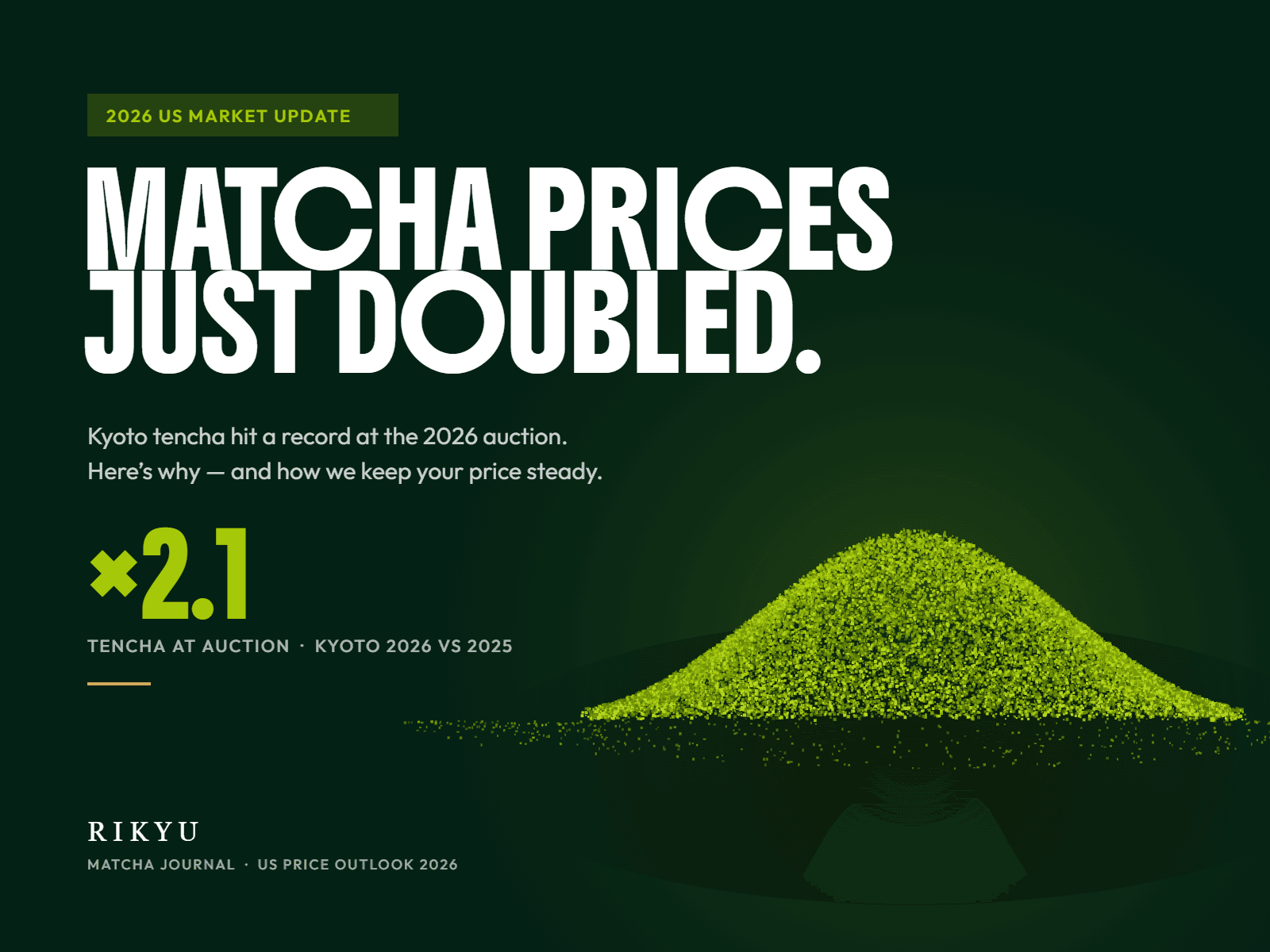
Over the past few months, something has changed in our inbox. Cafés and matcha brands across the United States that we had not heard from in a while are writing to ask the same thing: "Can you send us your current price list?" This is not a coincidence. In 2026, the cost of matcha in America has moved sharply, and buyers are re-checking every supplier they know. This article explains what happened, why it happened, and what we believe a supplier owes you in a year like this.
What is happening to matcha prices in the US?
Matcha has become one of the fastest-growing drinks on American café menus. Klatch Coffee in California was on track to sell four times more matcha than it did in 2022, and Adagio Teas reported that its wholesale matcha sales doubled year over year. Across the market, matcha sales jumped 86% between 2022 and 2025.
That demand has met a supply that cannot grow quickly, and prices have followed. Foodservice matcha prices in the US rose around 14% in a year, with organic matcha up more than 21%. Individual cafés have seen far worse: a Denver café had one supplier raise prices by 150% in a single month and found itself on a waitlist until August 2026 for its preferred farm. A Honolulu matcha business reported wholesale costs up 40–50%. Retail followed too: one premium 20g tin that sold for about $49 crossed $100 within months.
So when a buyer asks for a price list today, they are usually asking three questions at once: "How much did your price move?", "Can you actually ship?", and "Will the price move again next month?"
What happened at the tea auctions in Japan?
The root of the story is in Japan, at the spring tea auctions, where tencha (the shade-grown leaf that becomes matcha) is bought and sold.
At the Kyoto tea market, the opening auction on May 13, 2026 averaged ¥13,972 per kilogram for tencha (about $93 at ¥150 to the dollar), roughly 1.7 times the previous record of ¥8,235 (about $55) set in 2025. By the time the Uji market closed its spring season at the end of July, the average price for machine-harvested tencha stood at ¥17,250 per kilogram (about $115), the highest since records began in 1996, and the market handled 595 tons of tencha, the largest volume since it opened in 1974.
Kagoshima, Japan's biggest matcha-producing region, saw the same thing. Its 2026 tencha averaged ¥13,910 per kilogram (about $93), about 2.3 times the previous year, and JA officials described the result as "far exceeding expectations." Even in Shiga, a small producing area, the average price doubled and the top bid reached ¥180,000 per kilogram (about $1,200).
Two things make 2026 unusual. First, the price rose even though volume rose: Japan's first-flush harvest was up 21% across the major prefectures, yet the extra tea was absorbed immediately. Second, the price rise spread to teas that are not matcha at all. Because farmers are converting fields to tencha, sencha, gyokuro and even the cheap leaf used for hojicha have all become scarcer and more expensive. In Kyoto, the base material for hojicha quadrupled in two years.
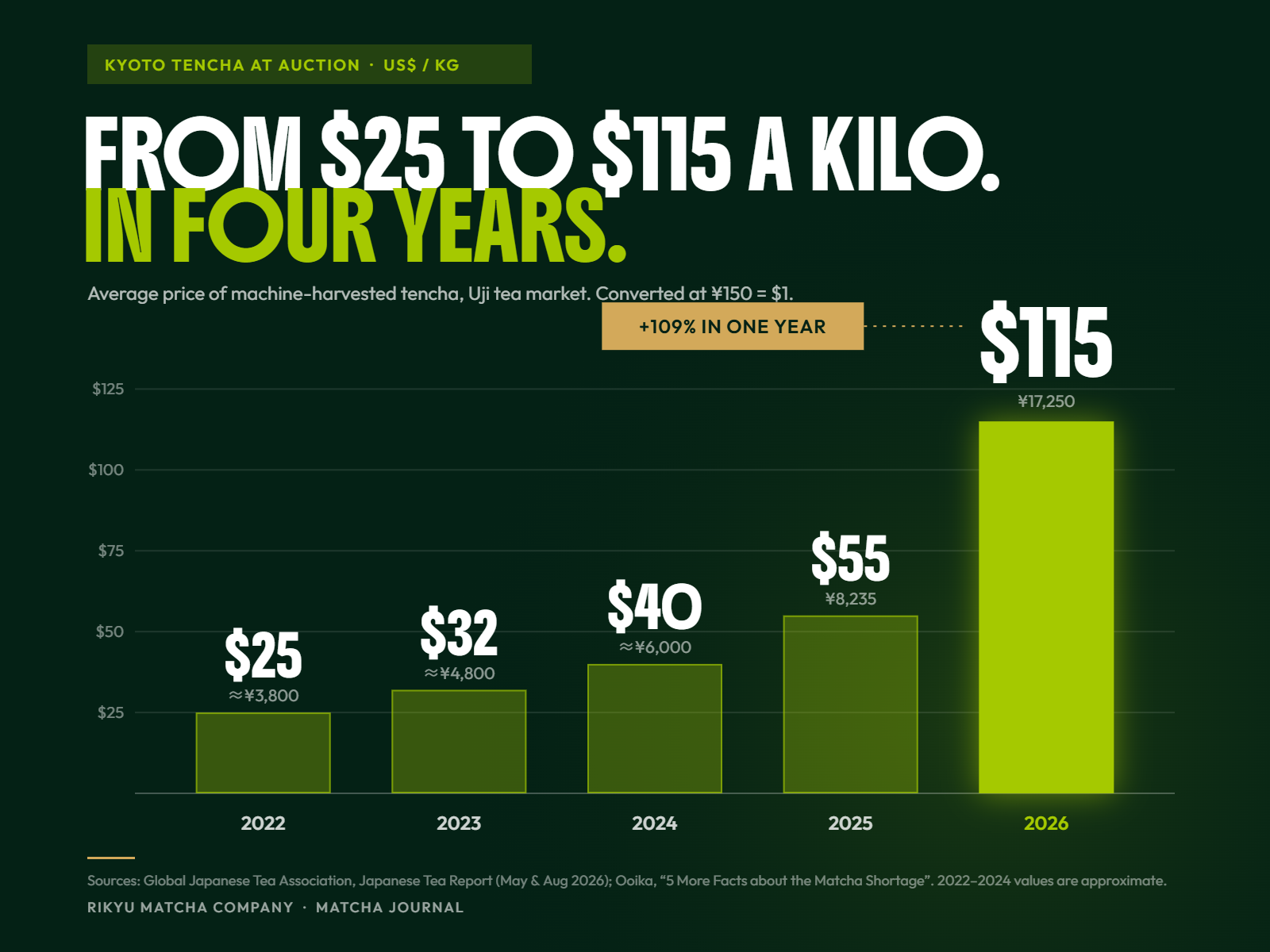
Chart: what a kilo of Kyoto tencha costs at auction, in US dollars (¥150 = $1). The 2026 season set a record.
Why can't supply simply catch up?
Tencha cannot be scaled like coffee. It needs shade structures, several years for a converted field to mature, and a single spring harvest that decides most of the year's supply. Meanwhile the number of tea farms in Japan has fallen from about 53,000 in 2000 to roughly 12,000 today, and more than 70% of the remaining farmers are over 65.
Demand, by contrast, is global and growing. Japan's green tea exports reached a record ¥48.3 billion (about $322 million) in the first half of 2026, up ¥22 billion (about $147 million) from the same period a year earlier, and the United States takes the majority of Japan's powdered green tea exports. This is the third matcha shortage in modern history, and like the 1996 and 2001 shortages, it is being driven mainly by American demand.
What about tariffs?
Here is the good news for US buyers. Tea has been carved out of the trade measures that affected other Japanese goods. The 15% reciprocal tariff on Japanese tea was removed on November 13, 2025, and unflavored matcha under HTS 0902.10 has entered the US duty-free since then. The Section 122 surcharge that ran from February to July 2026 exempted every green tea subheading, and the Section 301 duties that replaced it on July 24, 2026 also leave unflavored tea free.
In other words, the price rise you are seeing in 2026 is not a tariff story. It is an auction story. That matters, because a tariff can be repealed, but an auction price only comes down when the balance of farms and demand changes.
Where Rikyu Matcha stands
We source matcha directly from producers in Uji, Nishio, Yame, Shizuoka and Kagoshima, and supply cafés and wholesale buyers from our own team in Tokyo. We buy tencha in the same market as everyone else, and we will not pretend the 2026 auction did not happen. What we can control is how the volatility reaches you.
One price list, tiered by volume, no surprises. When you ask us for a price list, you receive a single sheet with volume tiers. We set it for the season, and if the market forces a change, you hear it from us first, with notice, not on your next invoice.
More than one region, so one bad harvest does not decide your menu. Kyoto and Kagoshima do not move in lockstep, and a supplier who buys from only one of them has no room to protect you. Sourcing across five regions is what lets us keep a café-grade blend at a steady price even when a single market spikes.
Stock in Tokyo, not a waitlist. Bulk orders ship the next day when they are in our warehouse, and in one to two weeks from the producer when they are not. That is what "can you actually ship?" should sound like.
Direct, bilingual, fast. Many of the buyers who write to us have the same complaint: the supplier in Japan stopped replying. We answer in English, directly from Tokyo, and we answer fast.
Matcha becoming expensive is not, in itself, bad news for a tea field in Uji or Kagoshima. Matcha becoming unpredictable is bad news for everyone. Our job in 2026 is to stand between the auction and your café, and to make sure that what reaches you is a bowl of tea and a number you can plan around.
If you would like our current price list, write to us directly. We will send it the same day.
FAQ
Why did matcha prices go up in 2026?
Global demand, led by US cafés, grew faster than Japan's shade-grown tencha supply. At the 2026 spring auctions, tencha averaged roughly double the 2025 price in both Kyoto and Kagoshima (around $90–115 per kilogram at ¥150 to the dollar), and that cost flowed through to wholesale and retail.
Are US tariffs raising the price of matcha?
No. Unflavored Japanese tea, including matcha, has entered the US duty-free since November 2025 and was exempt from the 2026 Section 122 and Section 301 measures. The increase comes from the auction price of the raw leaf.
Will matcha prices come down?
Not quickly. Tencha fields take years to establish, the farming population is ageing, and demand is still growing. Most industry observers expect prices to stay high through at least the 2027 harvest.
How can a café protect its margin?
Choose a supplier with a published, tiered price list, sourcing from more than one region, stock ready to ship, and a real person who answers. Then match the grade to the drink: a good latte grade does more for your margin than a ceremonial grade that never survives the milk.
Does Rikyu Matcha have stock available now?
Yes. Contact us for the current price list and lead times for your quantity.