Is Your Uji Matcha Really from Uji?
14 October, 2026
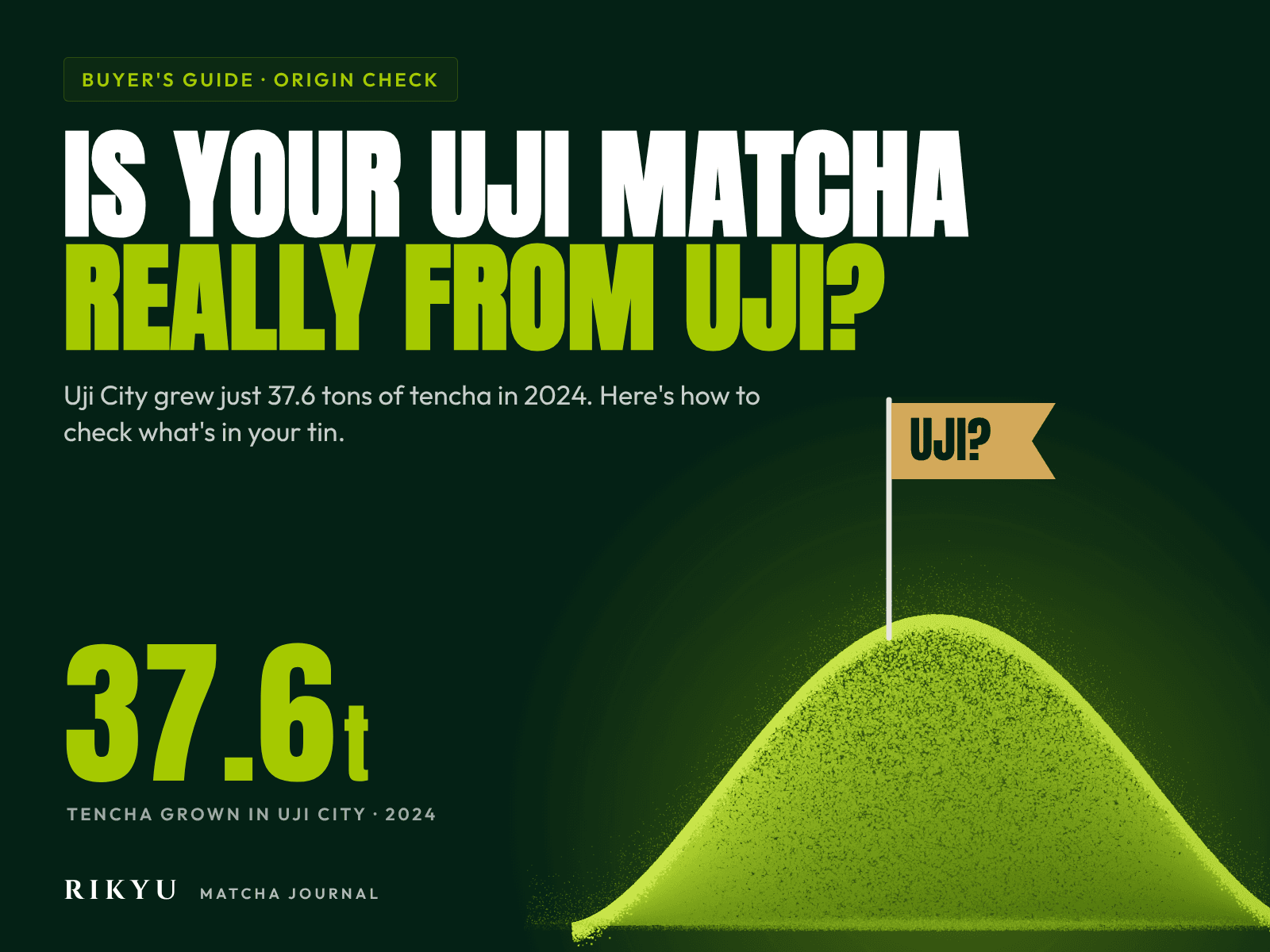
There is a saying in the tea trade that five times more “Uji matcha” is sold around the world than Uji actually produces. No official statistic backs that number up. But put the production figures next to what is on the market, and it becomes hard to dismiss.
In 2024, Uji City itself grew just 37.6 tons of tencha, the shade-grown leaf that is stone-ground into matcha. All of Kyoto Prefecture produced 1,057 tons. Chinese media, meanwhile, put China's 2025 matcha output at more than 12,000 tons. The figures are not measured the same way, but the gap is more than tenfold.
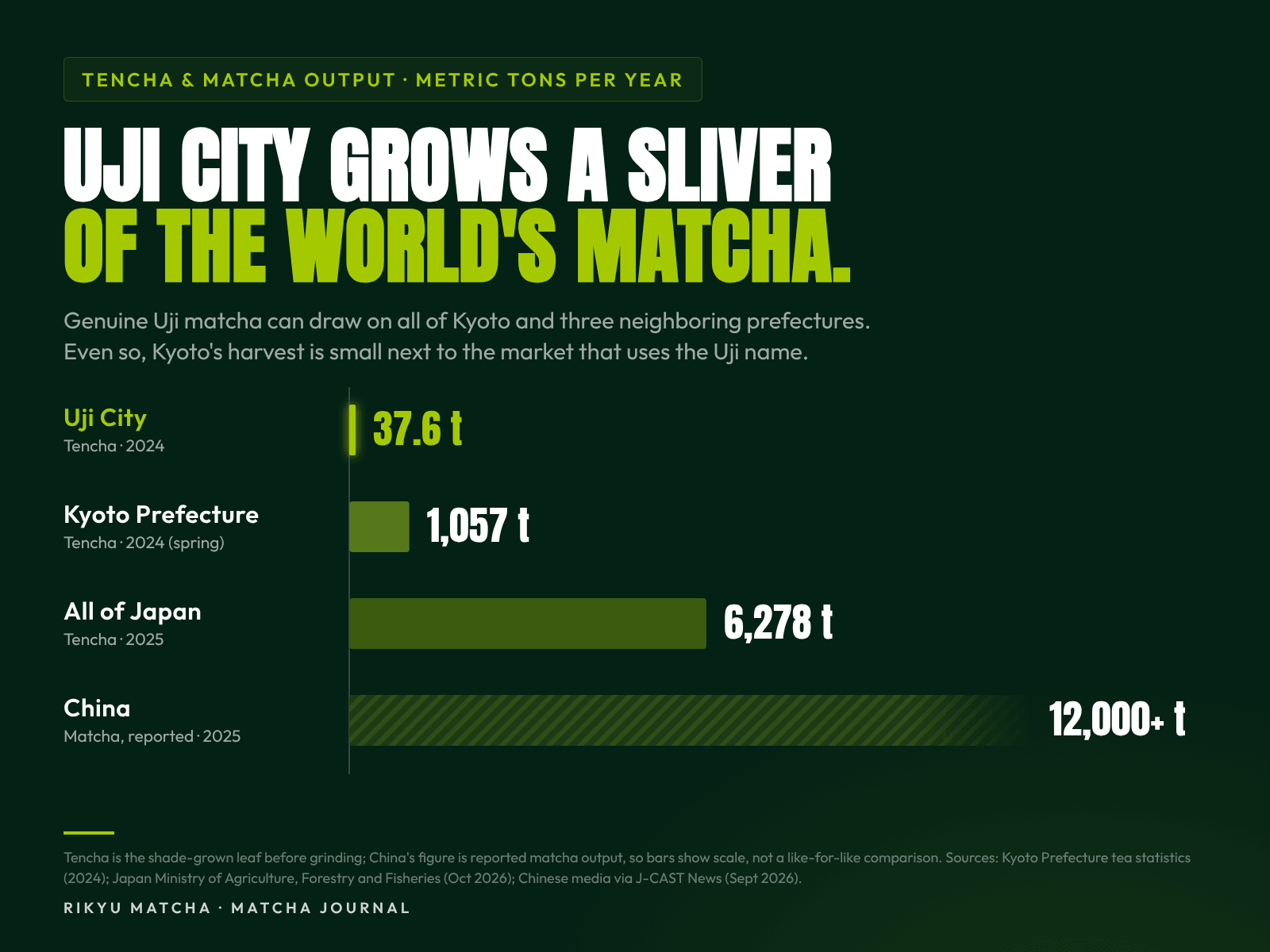
Chart: Uji City's tencha harvest next to Kyoto, all of Japan and China. Tencha is the leaf before grinding and China's figure is reported matcha output, so the bars show scale, not a like-for-like comparison.
This article explains why more “Uji matcha” is sold than Uji can grow, and what a café can do about it. The short answer: it comes down to who you buy from.
What does “Uji matcha” actually mean?
Uji matcha does not mean matcha made from tea grown in Uji City. In 2004, Kyoto's tea industry association set a definition for Uji tea. Today it covers green tea grown in four prefectures (Kyoto, Nara, Shiga and Mie) and finished inside Kyoto Prefecture by Kyoto-based companies, using methods that originated in the Uji area. The 2004 definition also gives priority to Kyoto-grown leaf.
A year earlier, a stricter rule requiring at least 50% Kyoto-grown leaf had been trialed. It was dropped, in part because there was not enough Kyoto leaf to go around. Uji has never had tea to spare.
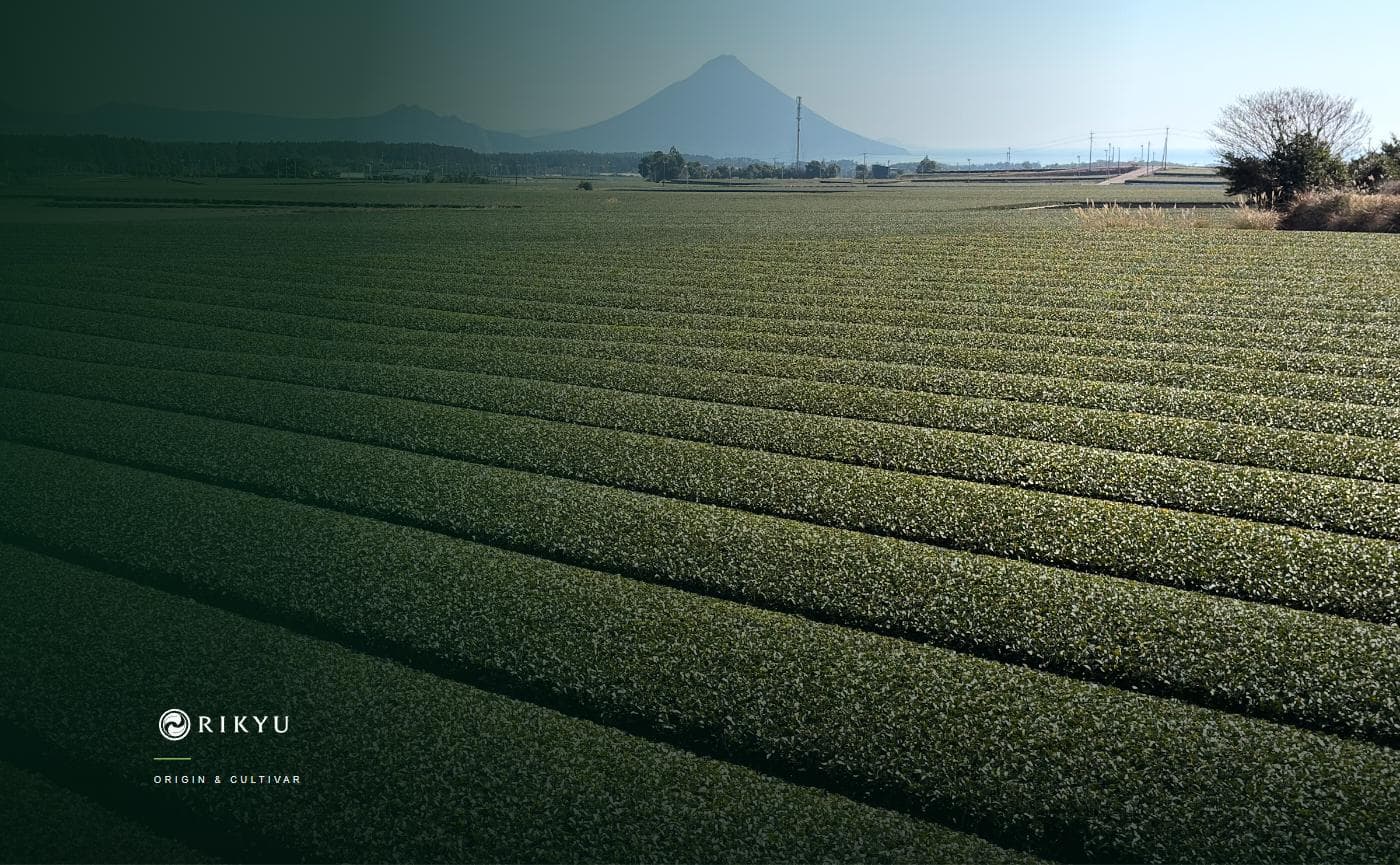
Even within Kyoto, Uji City is a small grower. In 2024, the town of Wazuka produced 549 tons of tencha, more than half of Kyoto's total, followed by Minamiyamashiro, Ujitawara and Kizugawa. Uji City came fifth. Genuine Uji matcha usually means matcha from the Uji region, not from Uji City.
In Japan, “Uji-cha” (Uji tea) has been a registered regional collective trademark since 2007, held by Kyoto's tea cooperative, and “Uji matcha” is registered as well. Those rights apply in Japan. On a shelf in Los Angeles or London, neither the definition nor the trademark applies automatically.
Related: Where Is Ujicha Grown? The Map Behind the Name
Why is more “Uji matcha” sold than Uji can grow?
There are four reasons: demand has exploded, Uji's supply cannot keep up, the name itself is worth money, and outside Japan there is little to check a label against.
Demand has exploded. Japan's green tea exports reached ¥72.1 billion (about $480 million at ¥150 to the dollar) in 2025, almost double the year before. Matcha and other powdered teas made up 84% of that value, and the United States took 35% of the volume, more than any other country.
Uji's supply cannot keep up. Japan harvested 6,278 tons of tencha in 2025, about 3.2 times as much as in 2014. Most of that growth happened outside Kyoto. Kyoto's tencha output has stayed between roughly 700 and 1,230 tons a year for the past decade, and Kagoshima is now Japan's largest tencha producer.
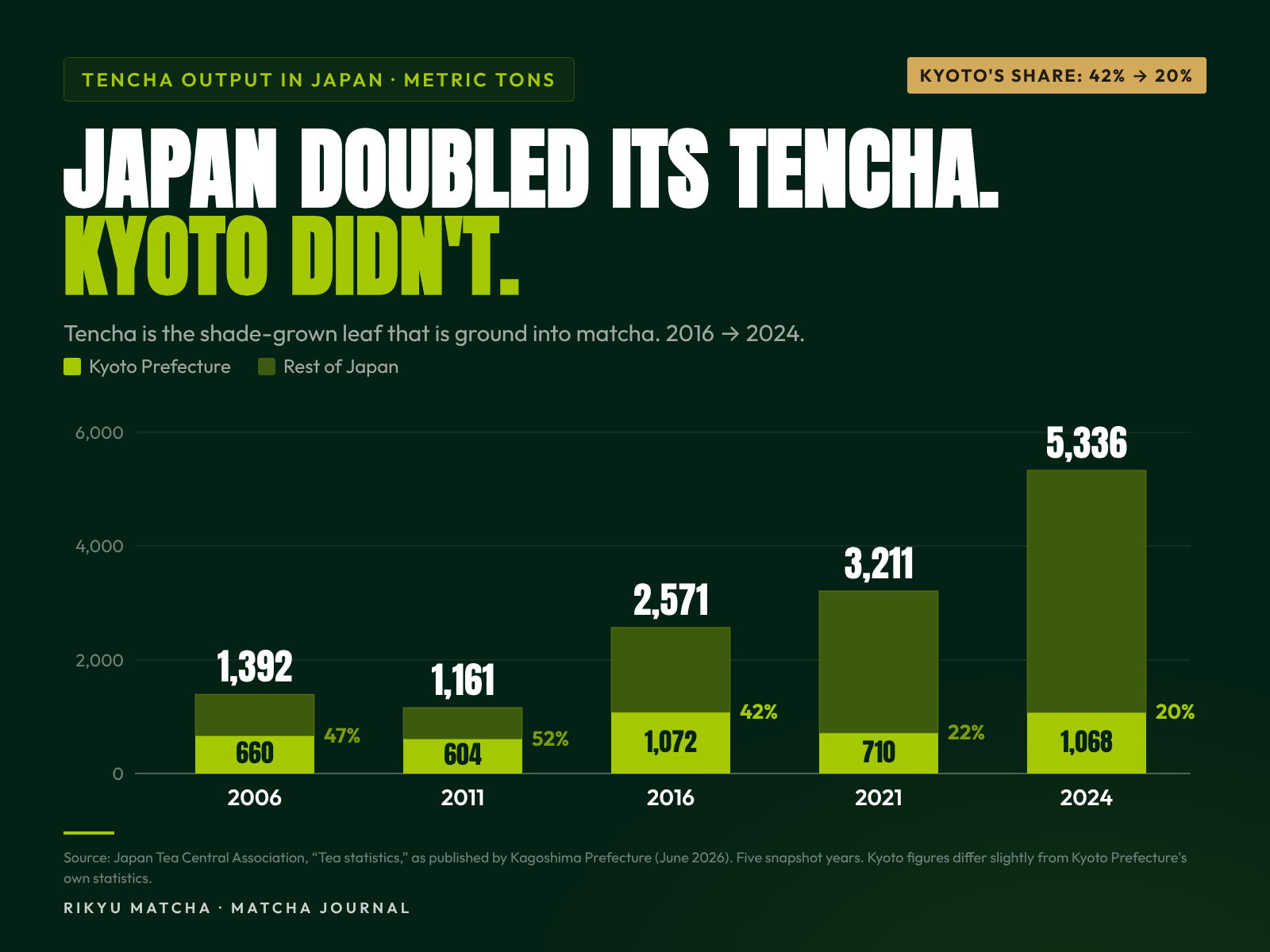
Chart: Japan's tencha output doubled between 2016 and 2024, while Kyoto's stayed at about 1,070 tons. Source: Japan Tea Central Association, via Kagoshima Prefecture (2026).
Grinding sets its own limit. A traditional stone mill produces only about 40 grams of matcha an hour. In a March 2025 report, Japan's agriculture ministry described a long-established Uji City tea house running 80 stone mills day and night and still turning orders away.
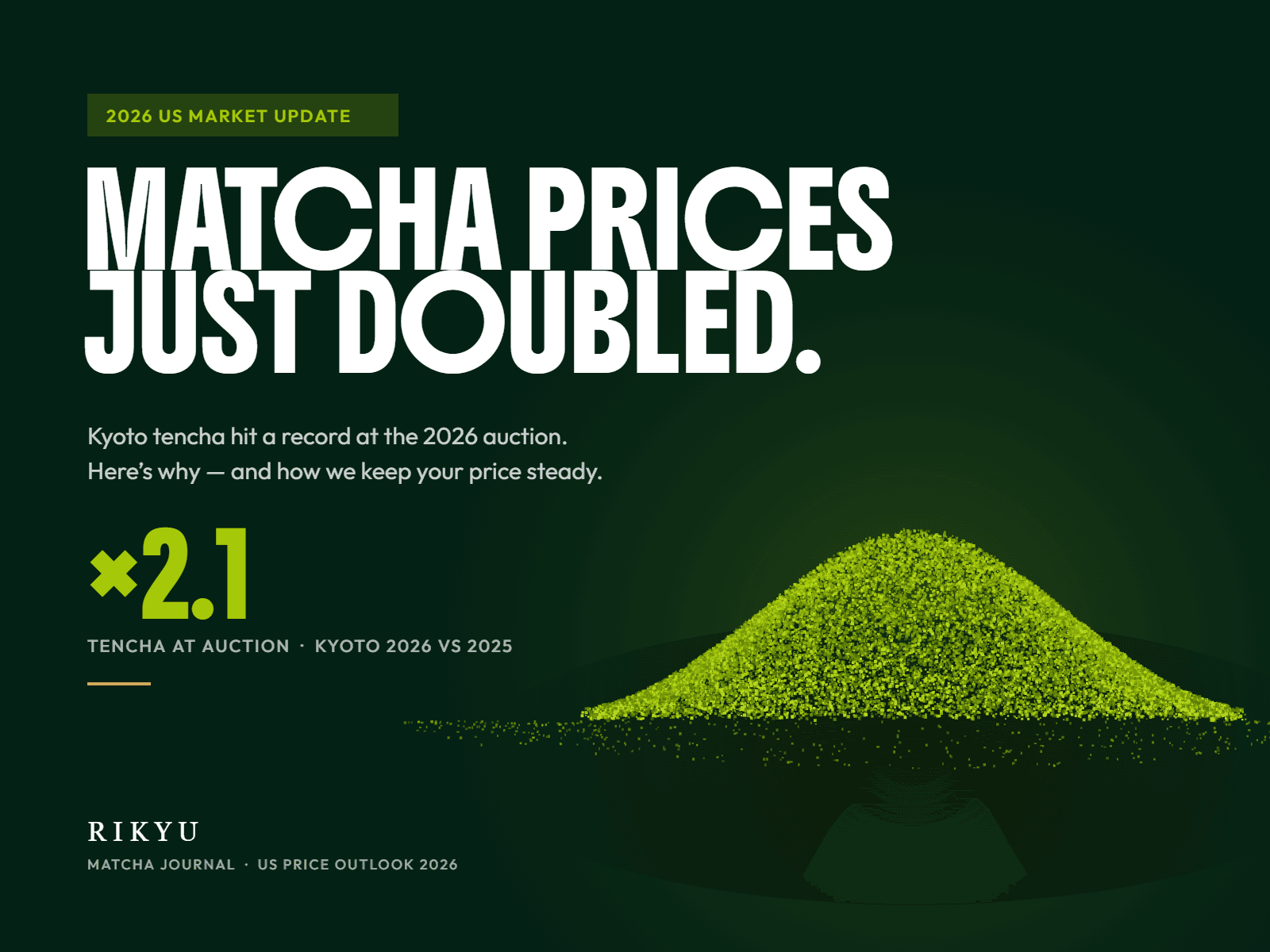
The name is worth money. Scarcity shows up in price. At the first Kyoto tencha auction of May 2026, tencha averaged about ¥14,000 per kilogram (roughly $93), around 1.7 times the 2025 level and the highest in a decade. The more real Uji leaf costs, the bigger the temptation to put the word “Uji” on something cheaper. We covered the 2026 auctions in Why US Cafés Are Asking for Price Lists in 2026.
Outside Japan, little checks the word “Uji.” According to Chinese media, China produced more than 12,000 tons of matcha in 2025, about 70% of the world's output, up from under 4,000 tons in 2020. Matcha grown in China is not the problem in itself. The problem is when it is sold as Japanese, or as Uji.
It happens. A Chinese product called “Uji Isuzu” copied the name and look of Isuzu, a well-known matcha from the Uji tea house Marukyu Koyamaen, and turned up in export markets. By September 2019, more than 3,000 trademark applications containing “Uji” had been filed in China across all categories. Kyoto's tea industry has fought back with oppositions and invalidation actions, and Chinese authorities have cancelled copycat marks. Yet Japanese media report that companies with “Uji” in their company names still market “Uji matcha.”
In October 2026, Japan's agriculture ministry listed Chinese-made “Uji matcha” as an example of rising intellectual property infringement. In July 2026, Japan registered “Japanese Tea” as a geographical indication, protecting the name for tea grown and processed in Japan. Abroad, protection is patchier: ABC News in Australia has reported that matcha labeling is almost completely unregulated, and that Japanese producers are increasingly worried about imitations.
Blending is not the problem. Mislabeling is. Uji matcha has traditionally been blended by tea masters, who combine leaf from several gardens to keep flavor and quality consistent. Blending is a legitimate craft. The problem starts when leaf from outside the definition, or from another country, goes into the blend and the label still just says “Uji.”
Related: Japanese Matcha vs. Chinese Matcha: Understanding the Difference
Why does every extra middleman matter?
Before it reaches a café abroad, matcha can pass through many hands: grower, refiner, exporter, importer, distributor, private-label brand and, finally, your café. At each step it can be repacked, blended or relabeled, and the origin details become a little more second-hand. Certificates and lot numbers do not always travel with the product.
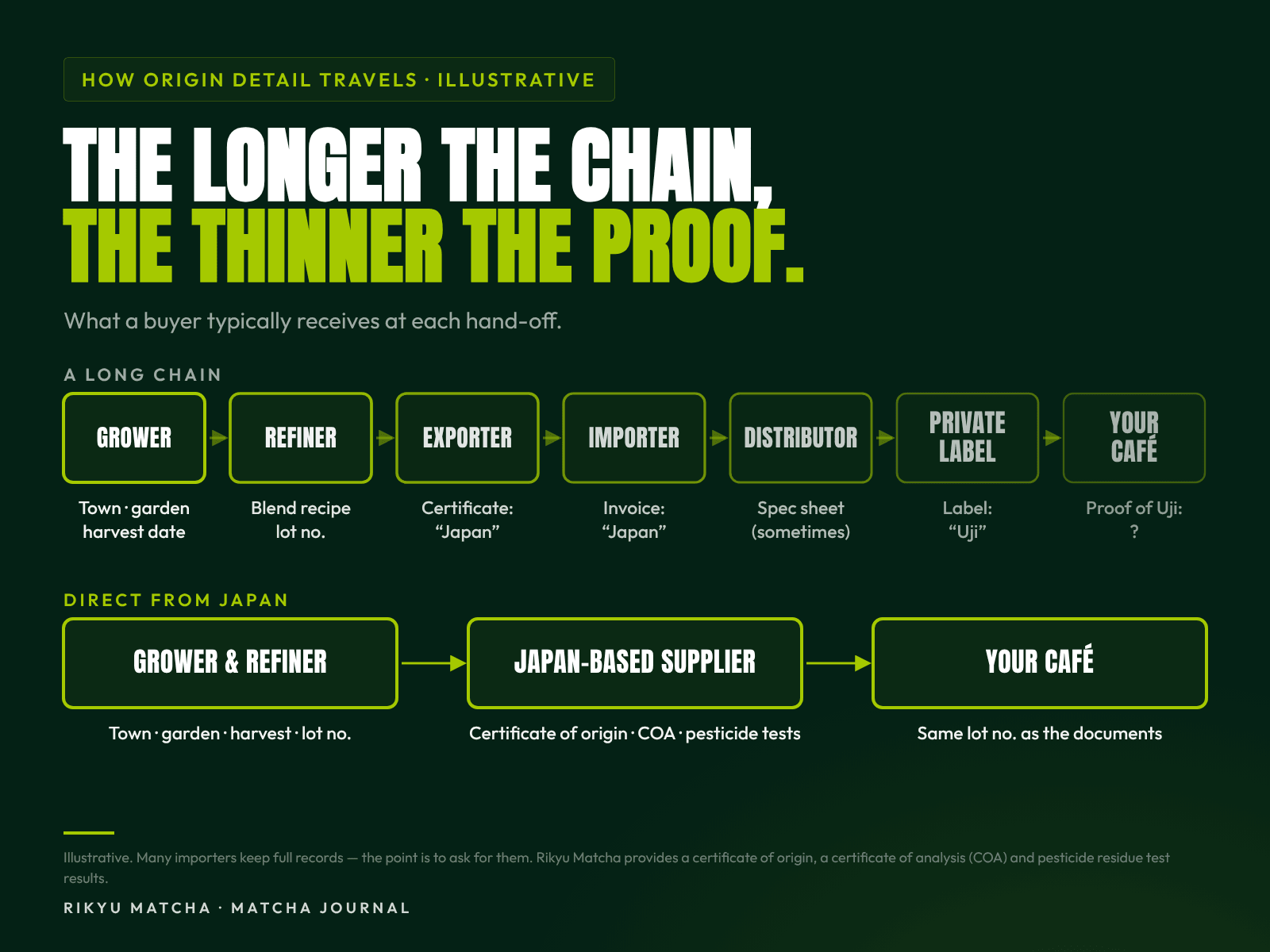
Diagram: the longer the supply chain, the less origin detail reaches the café. Illustrative.
For a café buying from a local distributor, “Uji” on the label is often third- or fourth-hand information. Even genuine Uji matcha can change: when leaf prices move sharply, the ratio of first- and second-harvest leaf in a product can shift while its name stays the same. A spec sheet for each lot is how you find out.
That is why you need to be careful if you are not buying directly from a supplier in Japan. The further you are from the source, the harder it is to verify the origin yourself, and the higher the risk that your “Uji matcha” is not Uji matcha at all. By “directly,” we mean buying from a Japan-based company that deals with growers and refiners itself, with no resellers in between. If you buy through an importer, ask whether they can show you the grower, the refining location and the lot details. If they can, you have something to check.
What should you ask your matcha supplier?
Origin is almost impossible to judge from the label, the color or the taste, even for experts. What you can check is the information behind the product. Ask your current supplier these seven questions.
Where was the tencha grown? Look for a town, not just a prefecture. For Uji matcha, the answer should be in Kyoto, Nara, Shiga or Mie; in Kyoto, expect names such as Wazuka or Ujitawara. Uji City grew under 40 tons of tencha in 2024, so be wary of large volumes sold as “grown in Uji City.”
Who refined it, and where? Under the Uji tea definition, it must be finished in Kyoto Prefecture by a Kyoto-based company.
Can you provide a certificate of origin? In Japan, these are issued by chambers of commerce. A certificate proves the tea is from Japan, not that it is from Uji, so check it together with the grower and the refining location.
Do you have a lot-numbered certificate of analysis (COA) and pesticide residue test results? The documents should match the product in your hands by lot number.
Is it first or second harvest? And will you tell me if the blend changes?
How many companies sit between you and the grower? If your supplier cannot say, their origin information may be hearsay too.
Does the price make sense? In May 2026, raw tencha averaged about $93 per kilogram at the first Kyoto auction. If “ceremonial-grade Uji matcha” arrives ground, packed and shipped across an ocean for far less, ask why.
Vague answers, or documents that never arrive, are a reason to pause. Be careful with wording such as “Uji-style” or “Kyoto blend,” which can describe a style rather than an origin.
Buy from a partner who can show you the source
Other regions are not second-best. Nishio, Yame, Shizuoka and Kagoshima all produce excellent matcha. What matters is that the origin on the label matches what is in the tin.
With demand for “Uji” running far ahead of supply, trusting the label alone is risky. Choose a supplier who can name the origin, show you the documents and tell you honestly when something changes. That protects your café and your customers.
Rikyu Matcha is based in Tokyo and sources matcha directly from producers in Uji, Nishio, Yame, Shizuoka and Kagoshima. We can provide a certificate of origin, a certificate of analysis (COA) and pesticide residue test results. If you would like to check the origin of the matcha you use now, write to us directly. We answer in English, from Tokyo, and we answer fast.
FAQ
Is Uji matcha only grown in Uji City?
No. Under the Kyoto tea industry's definition, Uji tea can be grown in Kyoto, Nara, Shiga or Mie, as long as it is finished in Kyoto Prefecture by a Kyoto-based company using Uji methods. Most of Kyoto's tencha comes from towns such as Wazuka, Minamiyamashiro and Ujitawara. Uji City grew 37.6 tons in 2024.
Is it true that five times more Uji matcha is sold than is produced?
It is a common saying in the trade, but no official statistic confirms it. What the data does show is that Kyoto's tencha output has stayed at roughly 1,000 tons a year while Japan's matcha exports and China's matcha output have multiplied.
Is Chinese matcha bad?
Not necessarily. The issue is not where it is grown but whether the label tells the truth. Matcha grown in China should be sold as Chinese matcha.
Does a certificate of origin prove my matcha is from Uji?
No. It shows the country of origin. To confirm Uji, you also need the growing area, the refiner and the lot details.
Can Rikyu Matcha provide origin documents?
Yes. We can provide a certificate of origin, a COA and pesticide residue test results. Contact us with the products you are interested in.
Sources
Japan Ministry of Agriculture, Forestry and Fisheries, “The State of Tea” (October 2026, Japanese)
MAFF geographical indication register No. 179, “Japanese Tea” (July 2026)
Kyoto Prefecture, tea production statistics for 2024 (Japanese)
Kagoshima Prefecture, the state of Kagoshima's tea industry (June 2026, Japanese)
MAFF Kinki Regional Office, definition of Uji tea (2024, Japanese)
MAFF Kinki Regional Office, matcha production in the Uji tea region (March 2025, Japanese)
Shokuhin Shimbun, first tencha auction of 2026 (May 21, 2026, Japanese)
Nihon Shokuryo Shimbun, Chinese imitations of Uji matcha (December 13, 2019, Japanese)
J-CAST News, China's matcha output and the “Uji” name (September 19, 2026, Japanese)